The Tools That Actually Work on 1-5 Minute Charts
Most indicators were designed for Daily or H4 charts. Slap RSI (14) on an M1 chart and you'll get whipsawed into oblivion — the signals come too late, too frequent, and too unreliable. Scalping requires faster, sharper tools with settings tuned specifically for short timeframes.
This lesson covers the best indicator stack for scalping, the exact settings to use, and how to combine them into a clean, actionable system.
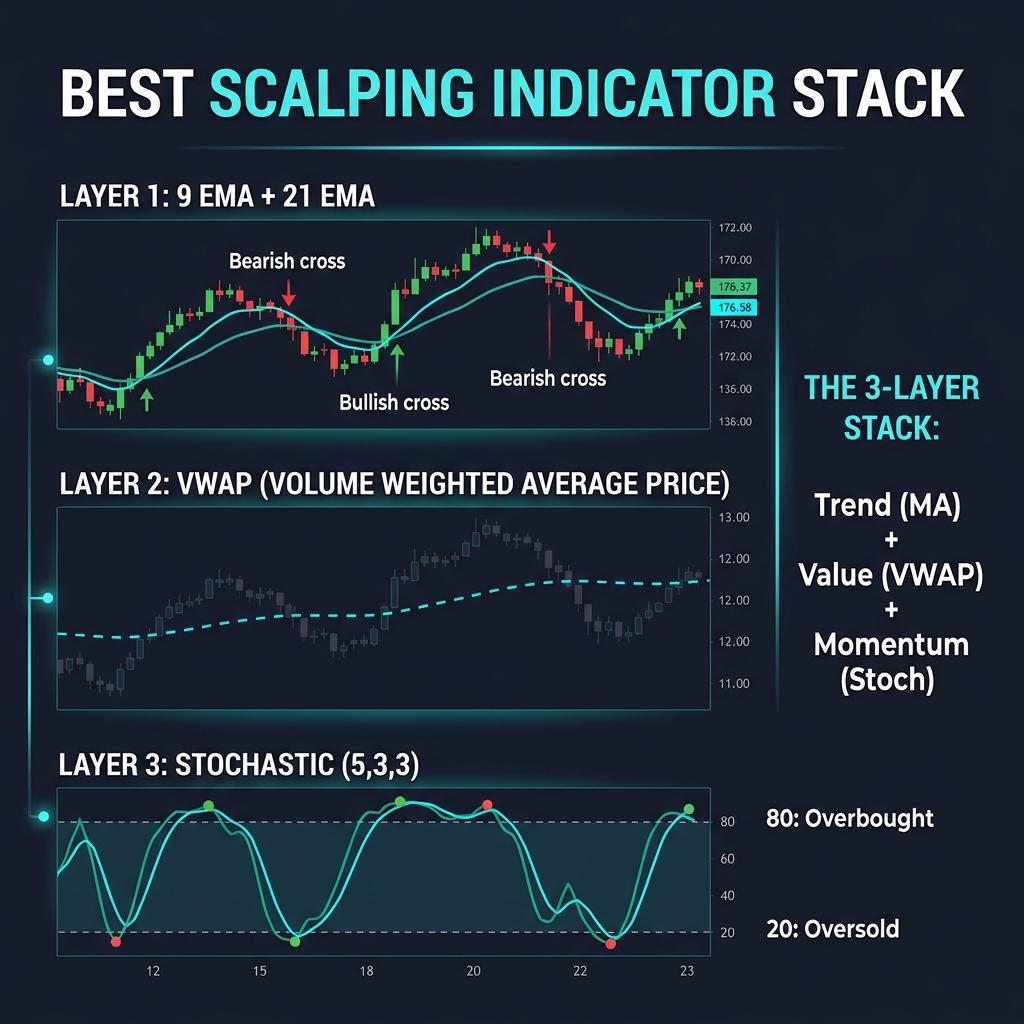
The Scalper's Indicator Stack
You don't need 10 indicators. You need exactly 3 layers:
Layer 1: Trend Direction — EMA Pair (9 and 21)
The 9 EMA and 21 EMA on M5 act as your trend compass. They react fast enough for scalping while filtering out pure noise.
| Situation | Reading | Action |
|---|---|---|
| 9 EMA above 21 EMA | Short-term bullish | Look for buy entries only |
| 9 EMA below 21 EMA | Short-term bearish | Look for sell entries only |
| EMAs intertwined/flat | No clear direction | Stay out — no trend to scalp |
Pro tip: Some scalpers add a 50 EMA as a "macro filter" — only scalp longs when price is above the 50 EMA, shorts when below. This reduces whipsaws significantly.
Layer 2: Value Reference — VWAP
VWAP (Volume Weighted Average Price) shows the average price weighted by volume for the current session. Institutional traders heavily reference VWAP, making it a natural magnet and support/resistance level.
- Price above VWAP: Buyers are in control — favor longs
- Price below VWAP: Sellers are in control — favor shorts
- Price touching VWAP: Potential entry zone for pullback entries
VWAP is especially powerful during the first 2 hours of London and first 2 hours of NY. As the session matures, VWAP becomes less reactive.
Layer 3: Momentum Trigger — Stochastic (5,3,3)
The Stochastic oscillator with fast settings (5,3,3) gives you the momentum trigger for timing entries. Standard settings (14,3,3) are too slow for scalping.
| Reading | Meaning | Scalping Action |
|---|---|---|
| Below 20 + crossing up | Oversold + momentum shifting up | Buy signal (if EMA trend is bullish) |
| Above 80 + crossing down | Overbought + momentum shifting down | Sell signal (if EMA trend is bearish) |
| Between 30-70 | No extreme | Wait — no trigger |
Combining the 3 Layers — The Complete Signal
A valid scalping signal requires all 3 layers to agree:
Buy Setup
- ✅ 9 EMA above 21 EMA (trend bullish)
- ✅ Price above or bouncing off VWAP (value confirms)
- ✅ Stochastic crossing up from below 20 (momentum trigger)
- → Enter long on next candle close
Sell Setup
- ✅ 9 EMA below 21 EMA (trend bearish)
- ✅ Price below or rejecting VWAP (value confirms)
- ✅ Stochastic crossing down from above 80 (momentum trigger)
- → Enter short on next candle close
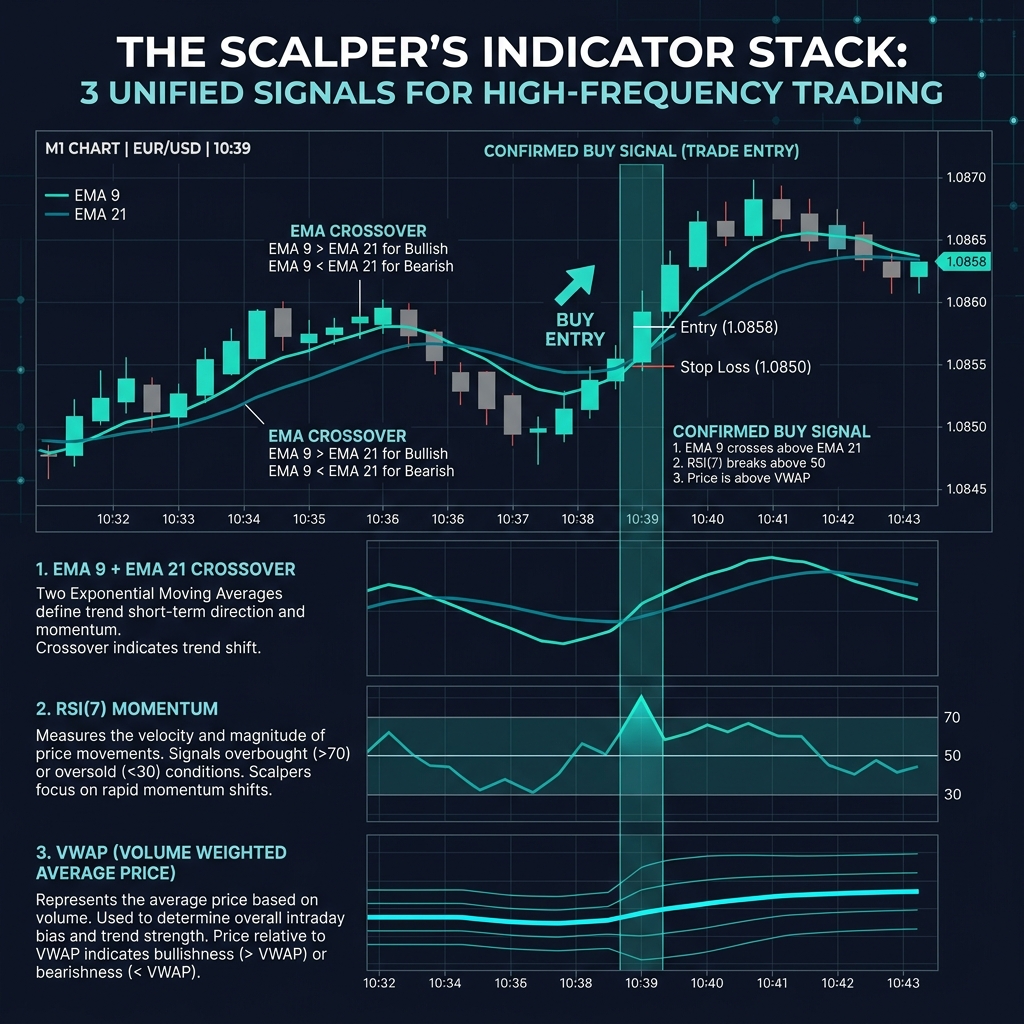
Real example — Buy scalp on EUR/USD M5:
- London open: 9 EMA crosses above 21 EMA at 1.0845
- Price pulls back to VWAP at 1.0840
- Stochastic drops to 18, then crosses up
- Enter long: 1.0842 | Stop: 1.0833 (9 pips) | Target: 1.0856 (14 pips)
- R:R = 1:1.5 | Price hits target in 7 minutes ✅
Other Useful Scalping Indicators
Bollinger Bands (20,2) — For Range Scalping
When the market is ranging, scalp bounces off the bands. Buy at the lower band, sell at the upper band. Works best when the bands are relatively flat.
RSI (7) — Fast RSI for M1-M5
Standard RSI (14) is too slow for scalping. RSI (7) gives faster signals. Use 30/70 as overbought/oversold — or 20/80 for fewer but stronger signals.
ATR (7) — Dynamic Stop Loss
Use ATR (7) on M5 to calculate your stop loss. Set SL at 1.5x ATR(7). This automatically adjusts to current volatility conditions.
What NOT to Use for Scalping
- Ichimoku Cloud: Too slow, too many elements, cloud lags badly on M1-M5
- MACD (12,26,9): Way too slow. By the time MACD signals on M5, the move is half over
- RSI (14): Too slow for M1-M5 — use RSI (7) if you must use RSI
- More than 3-4 indicators: If your chart looks like a rainbow, you have too many. Simplify.
Quick Recap
- Use a 3-layer stack: Trend (9/21 EMA) + Value (VWAP) + Momentum (Stochastic 5,3,3)
- All 3 layers must agree before entering a trade
- VWAP is most powerful during the first 2 hours of each major session
- Use fast indicator settings for M1-M5 — standard settings are too slow
- Keep your chart clean — 3 indicators maximum
🎯 Your Action Step
Set up your M5 chart with exactly these tools: 9 EMA + 21 EMA + VWAP + Stochastic (5,3,3). During the next London session, watch for setups where all 3 layers agree. Don't trade yet — just screen-capture each setup and note whether it would have been a winner or loser. After 10 setups, calculate your theoretical win rate.