The Single Number That Decides If You're Profitable
Here's a question that changes how you think about trading forever: Would you rather win 7 out of 10 trades, or 4 out of 10?
Most beginners instinctively say "7 out of 10!" But here's the twist — if your winners only make $50 and your losers cost $100, that 70% win rate still loses money. Meanwhile, a trader with 40% win rate who makes $300 on winners and loses $100 on losers is consistently profitable.
The secret? Risk-reward ratio (R:R). It's the single most important concept in trade math — and it's the reason pro traders can be wrong more often than right and still make money.
What Is Risk-Reward Ratio?
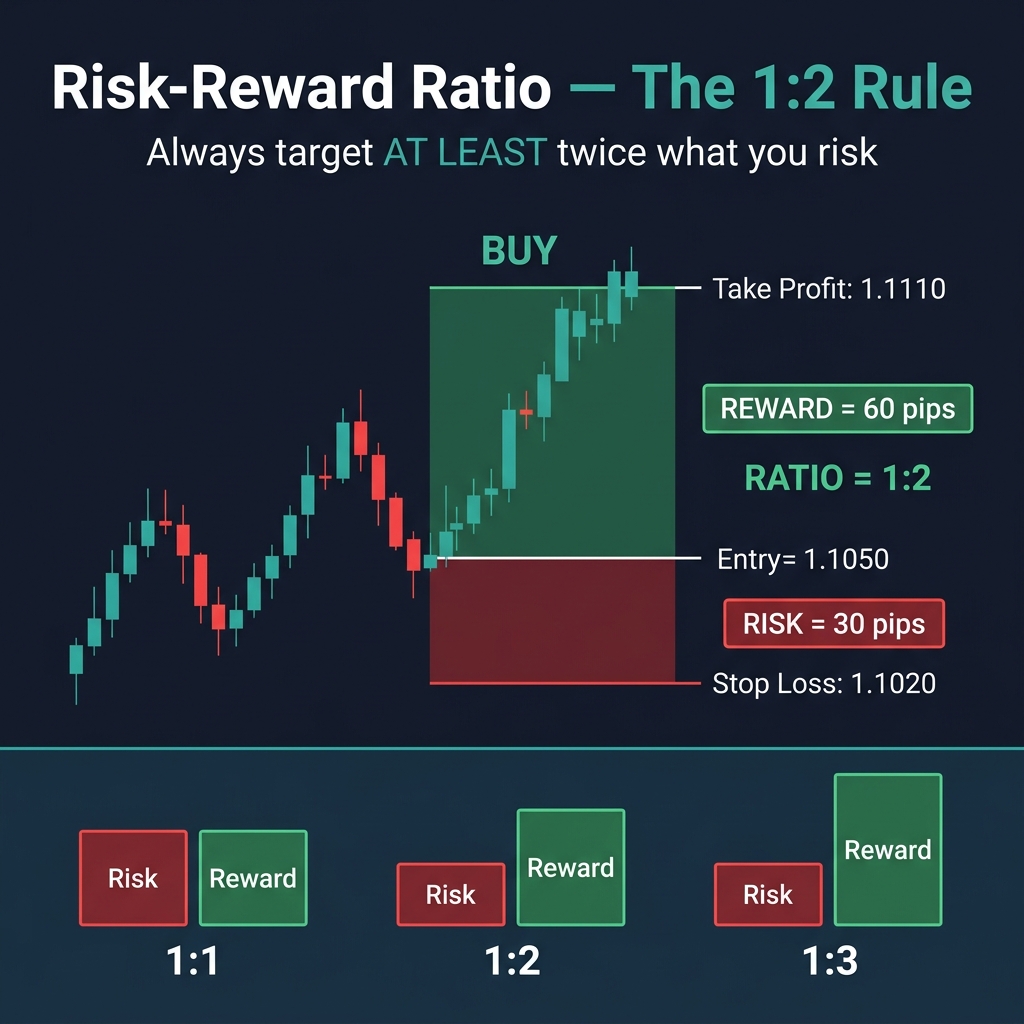
The risk-reward ratio compares how much you stand to lose vs. how much you stand to gain on a trade.
R:R = Potential Reward ÷ Potential Risk
Example: You buy EUR/USD at 1.1050. Your stop loss is at 1.1020 (30 pips risk). Your take profit is at 1.1110 (60 pips reward).
R:R = 60 ÷ 30 = 1:2 — for every $1 you risk, you stand to make $2.
How to Calculate Before Every Trade
| Component | Calculation | Our Example |
|---|---|---|
| Risk | Entry - Stop Loss | 1.1050 - 1.1020 = 30 pips |
| Reward | Take Profit - Entry | 1.1110 - 1.1050 = 60 pips |
| R:R Ratio | Reward ÷ Risk | 60 ÷ 30 = 1:2 |
Why the 1:2 Rule Changes Everything
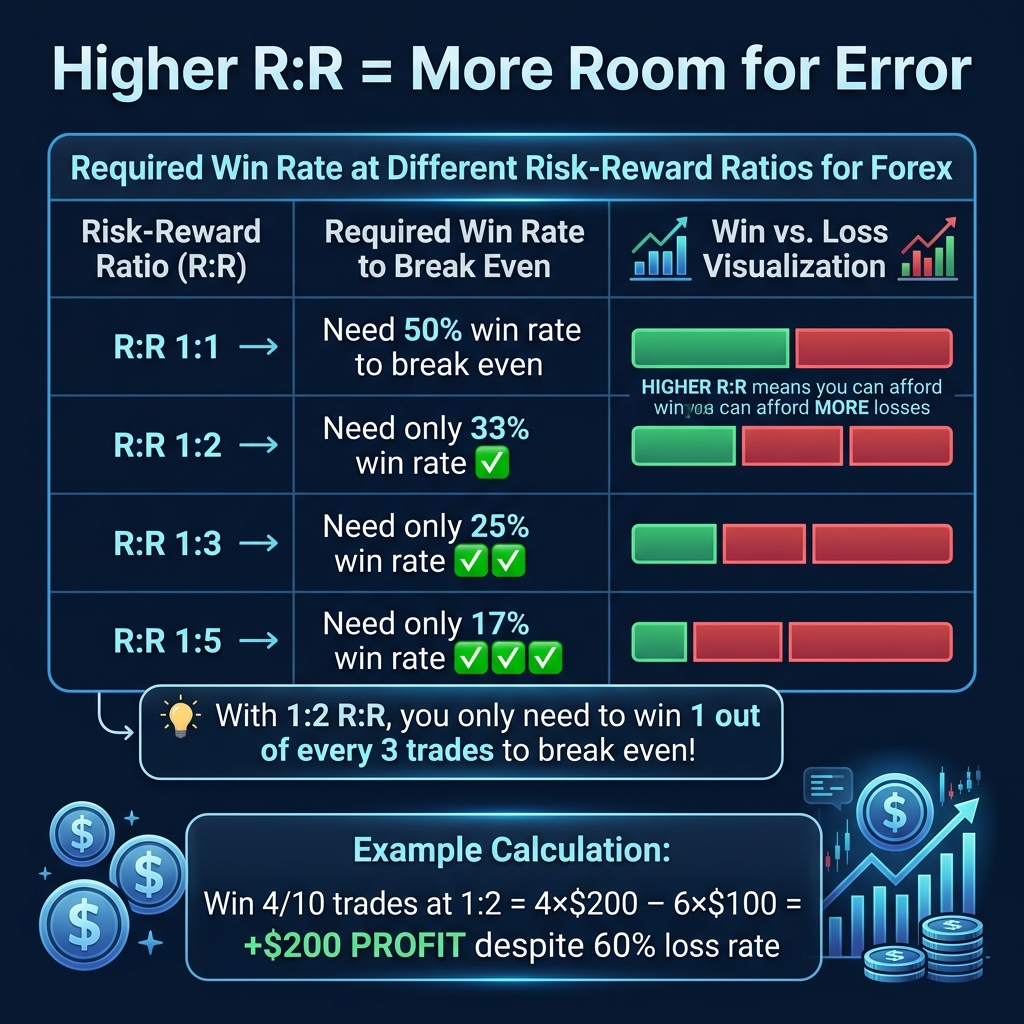
The magic of R:R is that higher ratios dramatically reduce the win rate you need to be profitable:
| R:R Ratio | Win Rate Needed (Breakeven) | Assessment |
|---|---|---|
| 1:1 | 50% | Need to win half your trades |
| 1:2 | 33% | Win just 1 of every 3 trades |
| 1:3 | 25% | Win 1 of every 4 trades |
| 1:5 | 17% | Win 1 of every 6 trades |
With a 1:2 ratio, you only need to win 34% of your trades to be profitable. That means you can lose two out of every three trades and still make money!
🎯 The golden rule: Never take a trade with less than 1:2 risk-reward. If the chart doesn't offer it, skip the trade.
Common R:R Mistakes
- "I'll just move my TP further to get better R:R" — Placing TP beyond the next resistance doesn't help. Price will likely reverse there.
- "1:1 is fine" — Only if your win rate is consistently above 55%. Most beginners don't achieve this.
- "Higher R:R is always better" — A 1:10 ratio sounds great, but the tradeoff is a much lower win rate. Balance matters.
Quick Recap
- ✅ R:R compares potential reward vs. potential risk
- ✅ Minimum standard: 1:2 ratio
- ✅ With 1:2, you only need a 33% win rate to break even
- ✅ Calculate R:R before every trade — if it's below 1:2, skip it
- ✅ Place TP at realistic levels (support/resistance), not arbitrary numbers