The Black Gold That Moves Entire Economies
Oil isn't just an energy source — it's a currency driver. When crude oil rises or falls, it directly impacts the currencies of countries that produce or consume it. Understanding the oil-forex connection gives you a powerful edge on CAD, NOK, and even USD pairs.
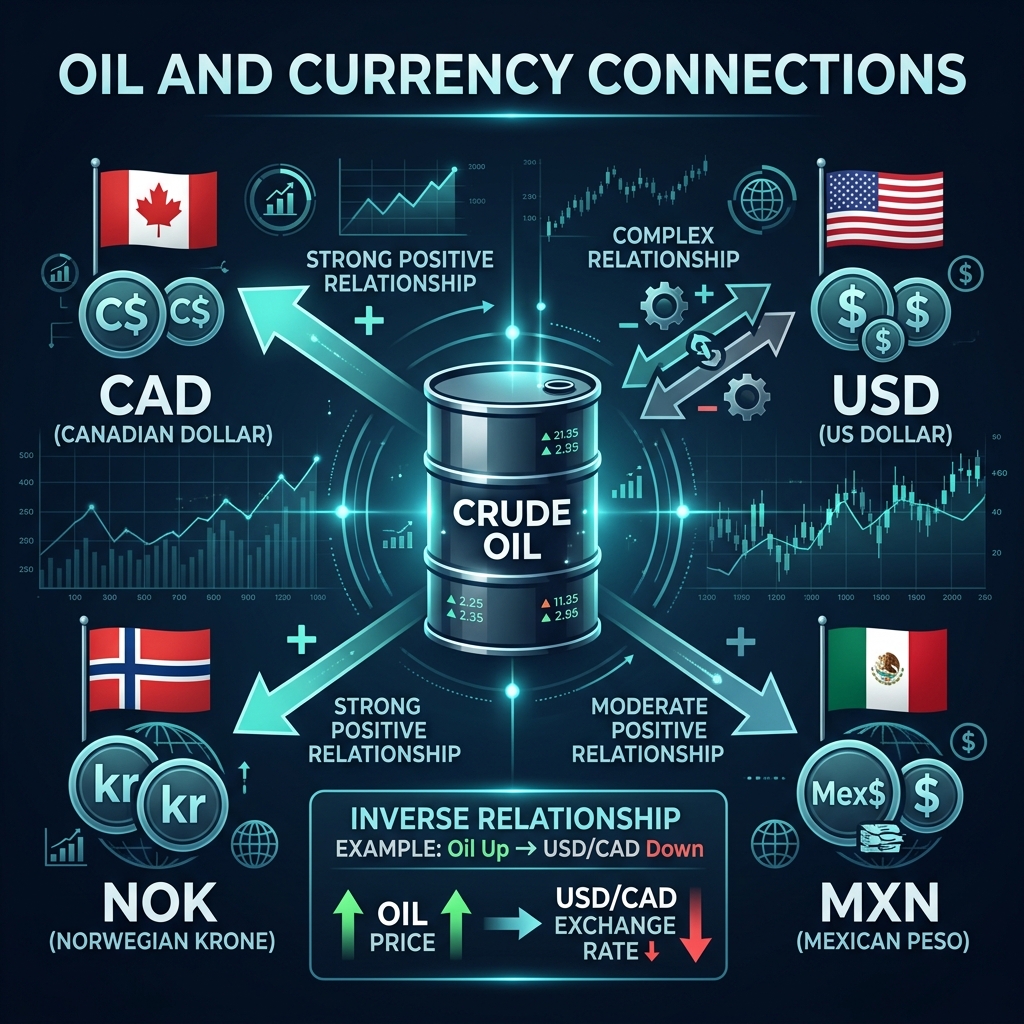
If you trade USD/CAD, this lesson is essential. If you trade any currency at all, it's still worth understanding — because oil moves the entire global risk picture.
The Petrocurrency Connection
Some currencies are directly tied to oil prices because their economies depend heavily on oil exports:
| Currency | Country | Oil Dependency | Correlation with Oil |
|---|---|---|---|
| CAD | Canada | Oil is ~20% of exports, oil sands are massive | Strong positive — oil up = CAD up |
| NOK | Norway | Largest oil producer in Western Europe | Strong positive — oil up = NOK up |
| RUB | Russia | Oil and gas are ~50% of exports | Very strong — but sanctions distort this |
| MXN | Mexico | Major oil exporter | Moderate positive |
The USD Side
The US is both a major oil producer AND consumer. The relationship is complex:
- Rising oil → inflation pressure → Fed may raise rates → USD bullish
- Rising oil → trade deficit narrows (US exports more energy now) → USD neutral/bullish
- Crashing oil → risk-off, recession fears → USD strengthens as safe haven
Oil and USD/CAD — The Key Trade
USD/CAD has one of the strongest and most tradeable correlations in forex:
- Oil rises → CAD strengthens → USD/CAD falls
- Oil falls → CAD weakens → USD/CAD rises
This is an inverse correlation: when oil goes up, USD/CAD goes down (because CAD is getting stronger).
How to Use This
- Check WTI crude before trading USD/CAD. If oil broke a key level, USD/CAD likely follows.
- Use oil as confirmation: If your system signals short USD/CAD AND oil is rallying, that's confluence.
- Avoid conflicting signals: Don't go long USD/CAD if oil is surging — you're fighting the macro flow.
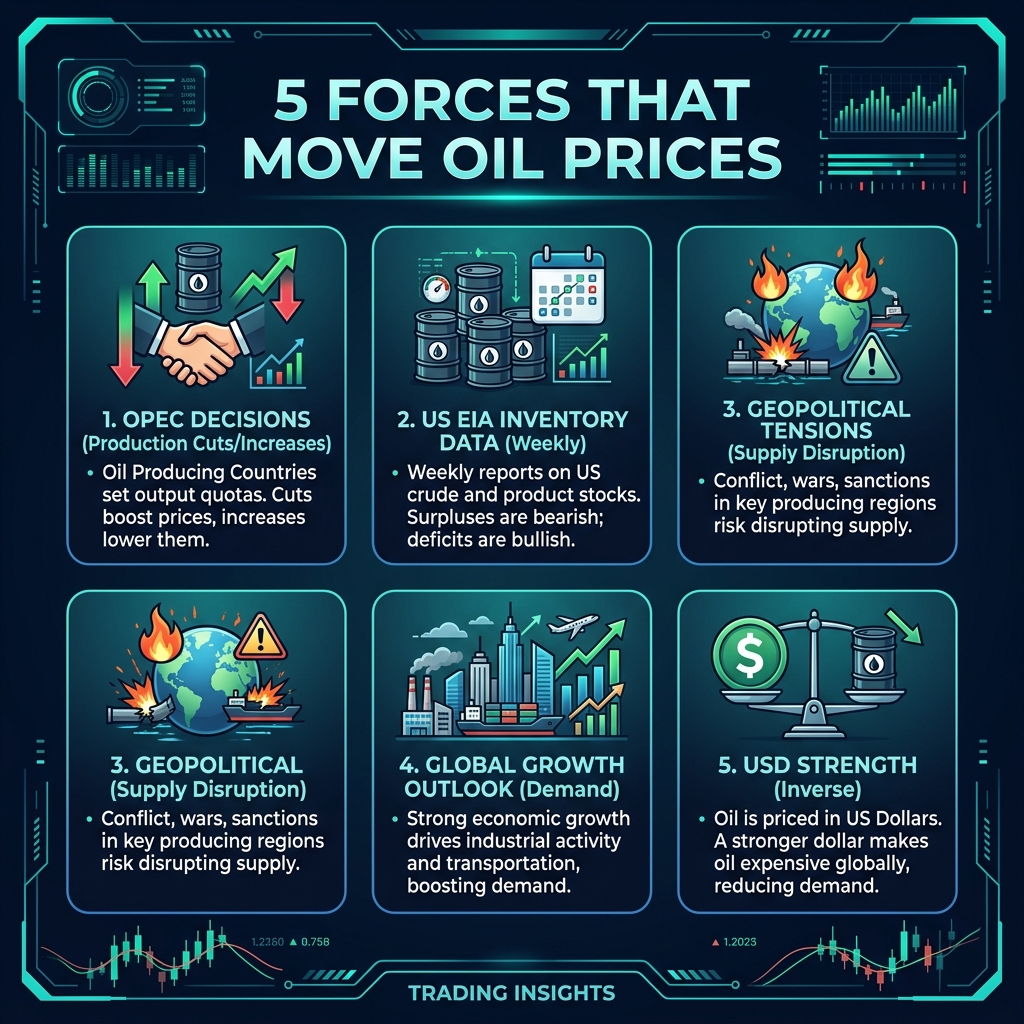
What Moves Oil Prices?
| Factor | Impact on Oil | Forex Effect |
|---|---|---|
| OPEC decisions | Production cuts → oil up; increases → oil down | CAD/NOK strengthen on cuts |
| US inventory data (EIA) | Bigger drawdown → oil up; build → oil down | Weekly event — watch USD/CAD |
| Geopolitical tensions | Middle East conflict → supply fear → oil spikes | Risk-off + oil up = complex: JPY up + CAD up |
| Global growth outlook | Strong growth → demand up → oil up | Risk-on: AUD/NZD/CAD all benefit |
| USD strength | Strong dollar → oil cheaper outside US → demand up, but supply adjusts | Usually inverse: DXY up = oil down |
Quick Recap
- Oil directly drives petrocurrencies: CAD, NOK, RUB, MXN
- USD/CAD has a strong inverse correlation with oil — oil up = USD/CAD down
- Check WTI crude before every USD/CAD trade as a macro filter
- Key oil movers: OPEC decisions, EIA inventory, geopolitics, global growth
- Oil spikes from geopolitics create complex cross-currents — risk-off + commodity-up simultaneously
- Add crude oil to your charting layout alongside forex pairs
🎯 Your Action Step
Open a WTI crude oil chart next to USD/CAD on TradingView. Zoom out to the daily timeframe and visually compare the last 3 months. You'll clearly see the inverse correlation. Then note the next scheduled EIA inventory report and OPEC meeting on your economic calendar — these are your oil-catalyst events.