You Don't Need to Predict the News — Just the Volatility
What if you could profit from a news release without knowing which direction the market will go? That's exactly what non-directional trading does. Instead of betting on the outcome, you bet on the size of the move — because one thing is guaranteed during NFP, CPI, and FOMC: the market WILL move.
This is the safer cousin of directional trading. You don't need a thesis. You just need volatility.
The Core Idea: Straddle the News
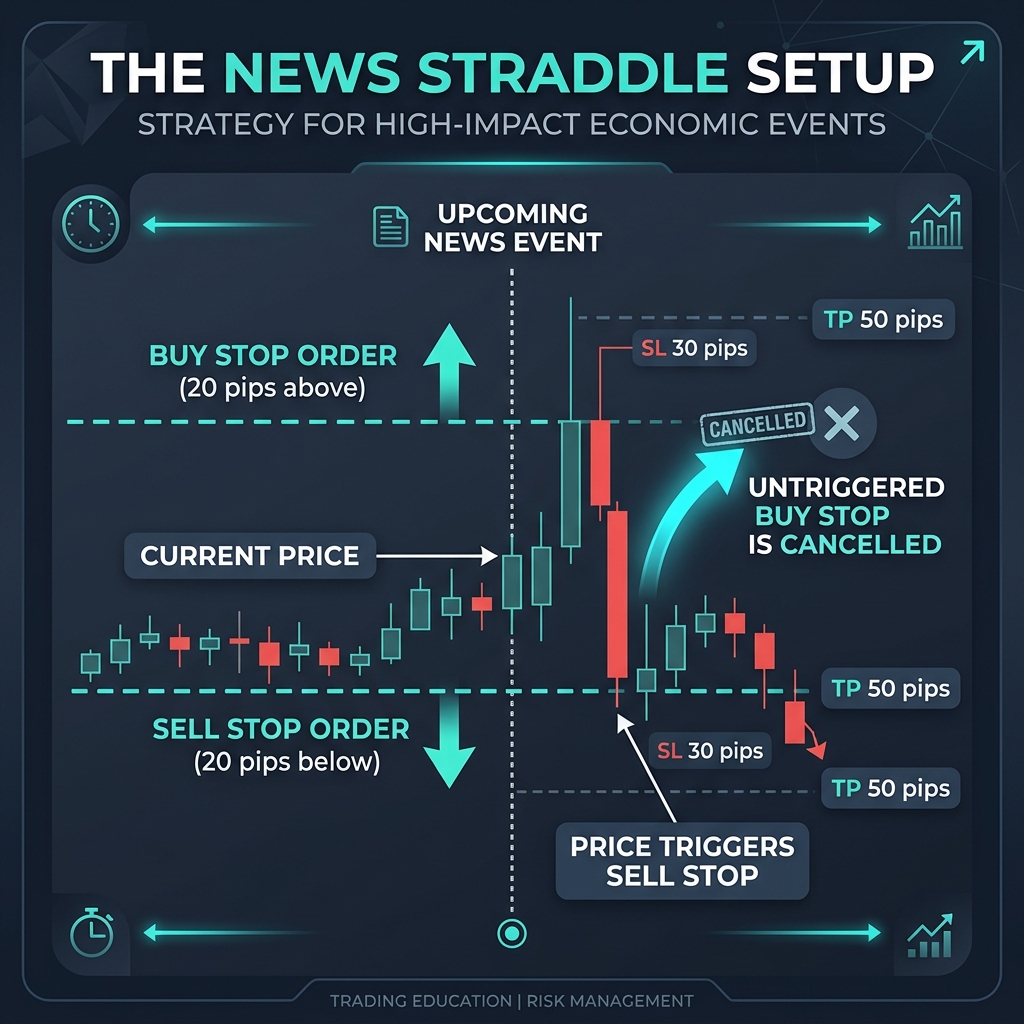
A non-directional news trade sets up entries on both sides of the current price. Whichever direction the market breaks, you're in the trade. The other order gets cancelled.
The Straddle Setup
- 5-15 minutes before the release: Note the current price
- Place a Buy Stop 15-20 pips ABOVE current price
- Place a Sell Stop 15-20 pips BELOW current price
- Each order has: Stop loss (25-30 pips) + Take profit (40-60 pips)
- When one order triggers: Cancel the other immediately
Why 15-20 Pips Away?
You need enough distance to avoid getting triggered by pre-release noise, but close enough to catch the initial surge. If you set orders too tight (5 pips), both will get triggered in the whipsaw. Too far (40 pips), and you miss most of the move.
Example: Straddle Trade on CPI
| Component | Detail |
|---|---|
| Pair | EUR/USD |
| Current Price | 1.0900 (10 minutes before CPI) |
| Buy Stop | 1.0920 (20 pips above) |
| Sell Stop | 1.0880 (20 pips below) |
| Stop Loss (each) | 30 pips from entry |
| Take Profit (each) | 50 pips from entry |
| R:R | 1:1.7 |
Scenario: CPI comes in hot → USD strengthens → EUR/USD drops → Sell Stop triggers at 1.0880 → Cancel Buy Stop → Price continues to 1.0830 → TP hit. ✅
The Breakout Approach (Alternative)
Instead of pending orders, some traders prefer the breakout approach:
- Wait for the release
- Let the first 5-minute candle complete
- Enter in the direction of the breakout candle (if it closes strong — full body, minimal wick)
- Stop loss: opposite end of the 5-minute candle
- Target: 1:2 risk-reward minimum
Advantage: You avoid whipsaws because you wait for confirmation.
Disadvantage: You miss the first 20-30 pips of the move.
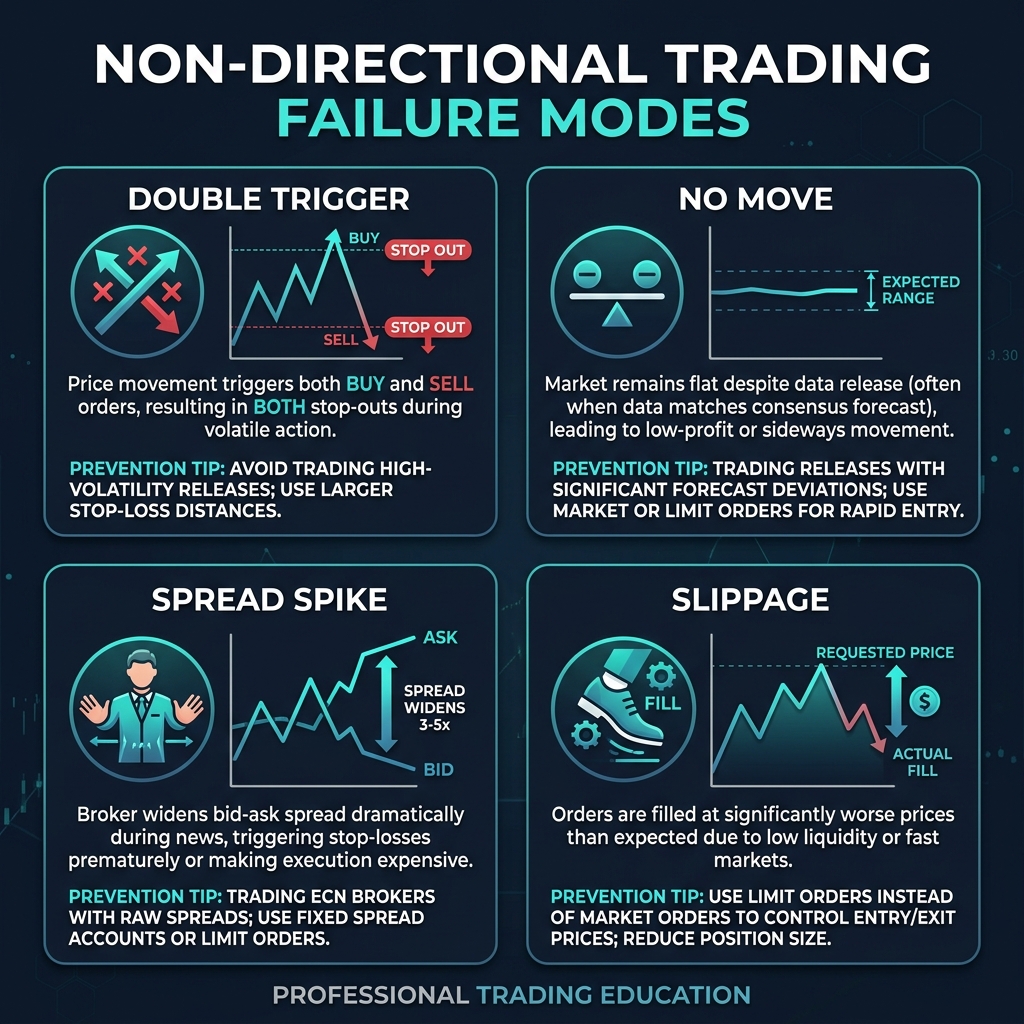
When Non-Directional Trading Fails
| Failure Mode | What Happens | How to Avoid |
|---|---|---|
| Double trigger | Price spikes up (triggers Buy), reverses (triggers Sell) — both hit SL | Space orders 20+ pips away, not 10 |
| No move | Data comes in exactly at forecast — market yawns | Only straddle high-impact events where big surprises are possible |
| Spread spike | Broker widens spread to 8-10 pips during release | Use an ECN/STP broker with tighter news spreads |
| Slippage | Your stop order fills 5-10 pips worse than expected | Account for slippage in your risk calculation |
Straddle vs Directional — Which Is Better?
| Factor | Directional | Non-Directional (Straddle) |
|---|---|---|
| Requires prediction? | Yes | No |
| Entry timing | Before release | Before or after release |
| Risk per trade | Higher (all-or-nothing) | Lower (hedged entry) |
| Potential reward | Higher (catch full move) | Lower (miss initial 15-20 pips) |
| Skill required | High (fundamental analysis) | Medium (execution focus) |
| Best for | Experienced traders with strong macro views | Traders who want exposure without prediction |
Quick Recap
- Non-directional trading profits from volatility, not direction
- The straddle places Buy Stop + Sell Stop on both sides of price before the release
- Space orders 15-20 pips away to avoid whipsaw triggers
- The breakout approach waits for the first 5-min candle to confirm direction
- Main risks: double triggers, spread widening, and slippage
- Only use on high-impact events where big moves are expected
🎯 Your Action Step
On the next CPI or NFP release, practice the straddle setup on a demo account. Place your Buy Stop and Sell Stop 20 pips from the pre-release price, with 30-pip stops and 50-pip targets. Watch what happens. Did one order trigger cleanly? Did you get whipsawed? Record the result. Do this 3 times on demo before risking real money.