The Days That Delete Trading Accounts
Three letters: NFP. Three letters: CPI. Four letters: FOMC. These aren't just acronyms — they're the most dangerous and most profitable moments in forex. In under 60 seconds, a single data release can move the market more than it moves in an entire week of normal trading.
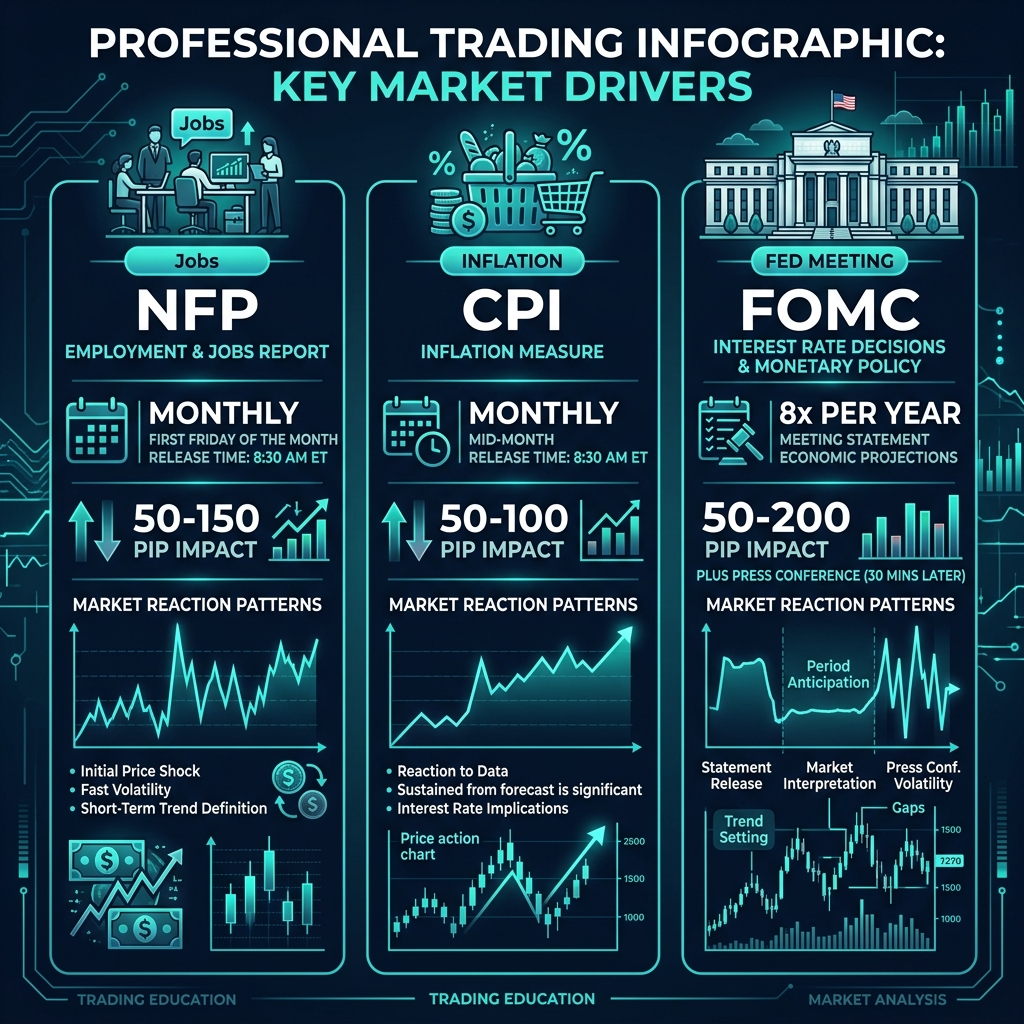
This lesson teaches you exactly what these releases are, how they move currencies, and whether you should trade them or avoid them entirely.
NFP — Non-Farm Payrolls
Released on the first Friday of every month at 8:30 AM Eastern, NFP is the single most anticipated economic release in forex. It reports how many jobs the U.S. economy added or lost in the previous month — excluding agricultural workers.
Why NFP Moves Markets So Hard
- Jobs = consumer spending = 70% of US GDP
- Strong jobs → hawkish Fed → USD rises
- Weak jobs → dovish Fed → USD drops
- Typical move: 50-150 pips in the first 5 minutes
Key Numbers Within NFP
| Data Point | What to Watch |
|---|---|
| Headline NFP Number | How many jobs were added — compare to forecast |
| Unemployment Rate | Lower = stronger economy, but too low can mean overheating |
| Average Hourly Earnings | Wage inflation — the Fed watches this MOST closely |
| Revision to Previous Month | If last month's number gets revised up/down, it changes the picture |
CPI — Consumer Price Index
CPI measures inflation — the rate at which prices for everyday goods and services are rising. It's released monthly, usually mid-month at 8:30 AM Eastern.
Why CPI Is the New King
Since 2022, CPI has arguably become more important than NFP. Why? Because central banks globally shifted focus from employment to inflation. The market now treats CPI as the direct predictor of the next rate decision.
What to Focus On
| CPI Component | What It Tells You |
|---|---|
| Core CPI (ex food & energy) | The Fed's preferred measure — strips out volatile items |
| Headline CPI | Includes everything — more volatile, but media focuses on this |
| Month-over-Month (MoM) | Shows the recent trend — more actionable than YoY |
| Year-over-Year (YoY) | The big picture — is inflation trending up or down? |
Hot CPI (above forecast): → Rate hike expectations rise → USD strengthens
Cool CPI (below forecast): → Rate cut expectations rise → USD weakens
FOMC — Federal Open Market Committee
The FOMC is the Fed's decision-making body. They meet 8 times per year and announce their interest rate decision + release a statement explaining their reasoning.
Why FOMC Is Different From Other Releases
Unlike NFP and CPI (data releases), FOMC is a decision. The market doesn't just react to a number — it reacts to:
- The rate decision itself (hike, cut, hold)
- The statement language (hawkish or dovish shift)
- The dot plot (updated 4x/year — shows each member's rate forecast)
- The press conference (Fed Chair Q&A — 30 minutes of market-moving commentary)
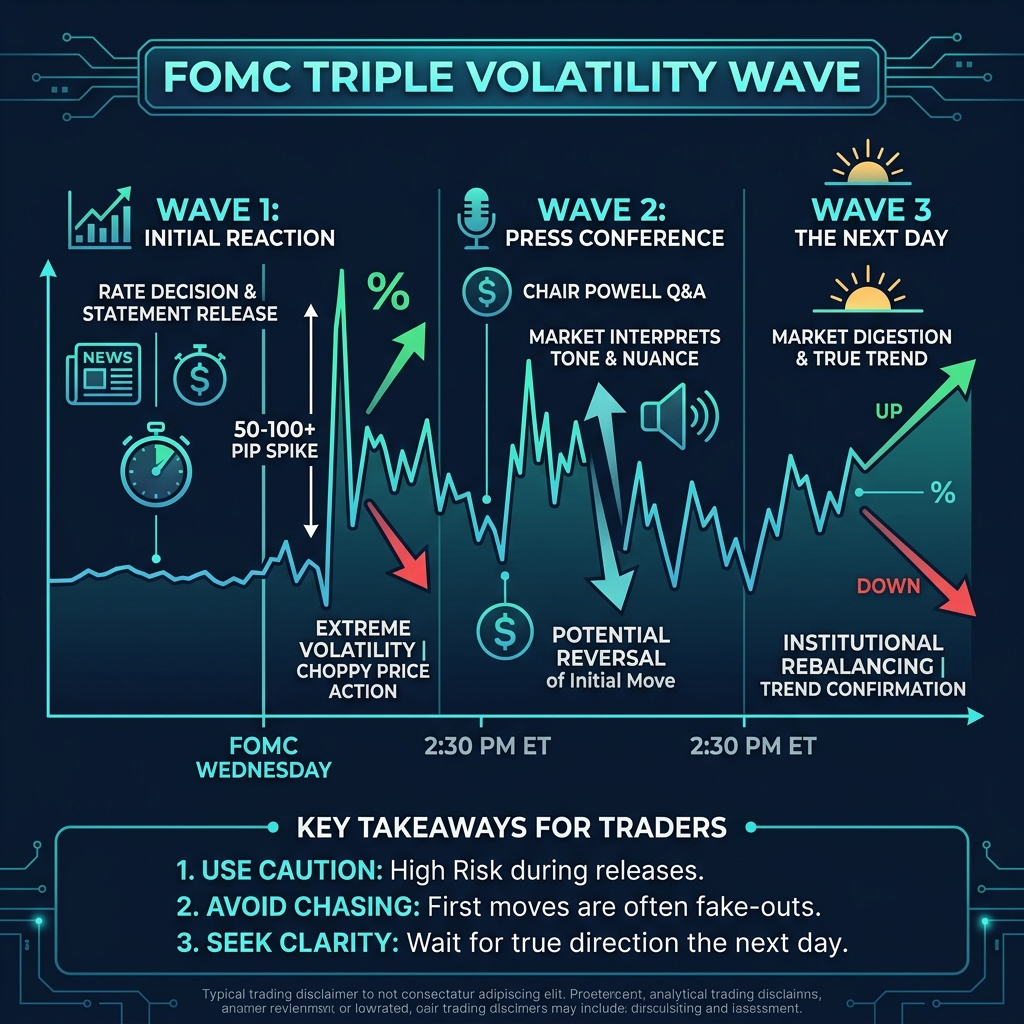
The Triple Volatility Wave
- Wave 1 (2:00 PM ET): Rate decision + statement released → initial 50-100 pip spike
- Wave 2 (2:30 PM ET): Press conference begins → can reverse the initial move completely
- Wave 3 (next day): Market digests the full information → trend begins
The Universal Rule: Actual vs Forecast
This applies to ALL economic releases — not just the big three. The market moves based on one simple equation:
Market Reaction = Actual Result − Market Expectation
- Actual > Forecast → Currency strengthens (for growth/employment data)
- Actual < Forecast → Currency weakens
- Actual = Forecast → Minimal reaction ("priced in")
Exception: For inflation data, higher than expected strengthens the currency (because it means rate hikes), but too high can be bearish if it signals economic instability.
Quick Recap
- NFP (monthly) = jobs report → moves USD 50-150 pips → watch wage growth especially
- CPI (monthly) = inflation → now the MOST important release → Core CPI matters most
- FOMC (8x/year) = rate decision + statement + press conference → triple volatility wave
- The reaction is always about actual vs forecast — never the number in isolation
- Never trade during the release — wait for the initial chaos to clear
- The press conference / statement language often matters more than the headline number
🎯 Your Action Step
Go to ForexFactory.com and find the dates for the next NFP, CPI, and FOMC releases. For each one, write down: (1) the forecast number, (2) the previous number, (3) what USD should do if actual beats forecast. Then watch the release live — was your prediction correct? Doing this 3 times will give you a permanent feel for how news moves markets.