The Crowd Is Always Wrong — At Exactly the Wrong Time
Technical analysis tells you what price is doing. Fundamental analysis tells you why. But sentiment analysis tells you what everyone thinks is about to happen — and that's often the most powerful signal of all.
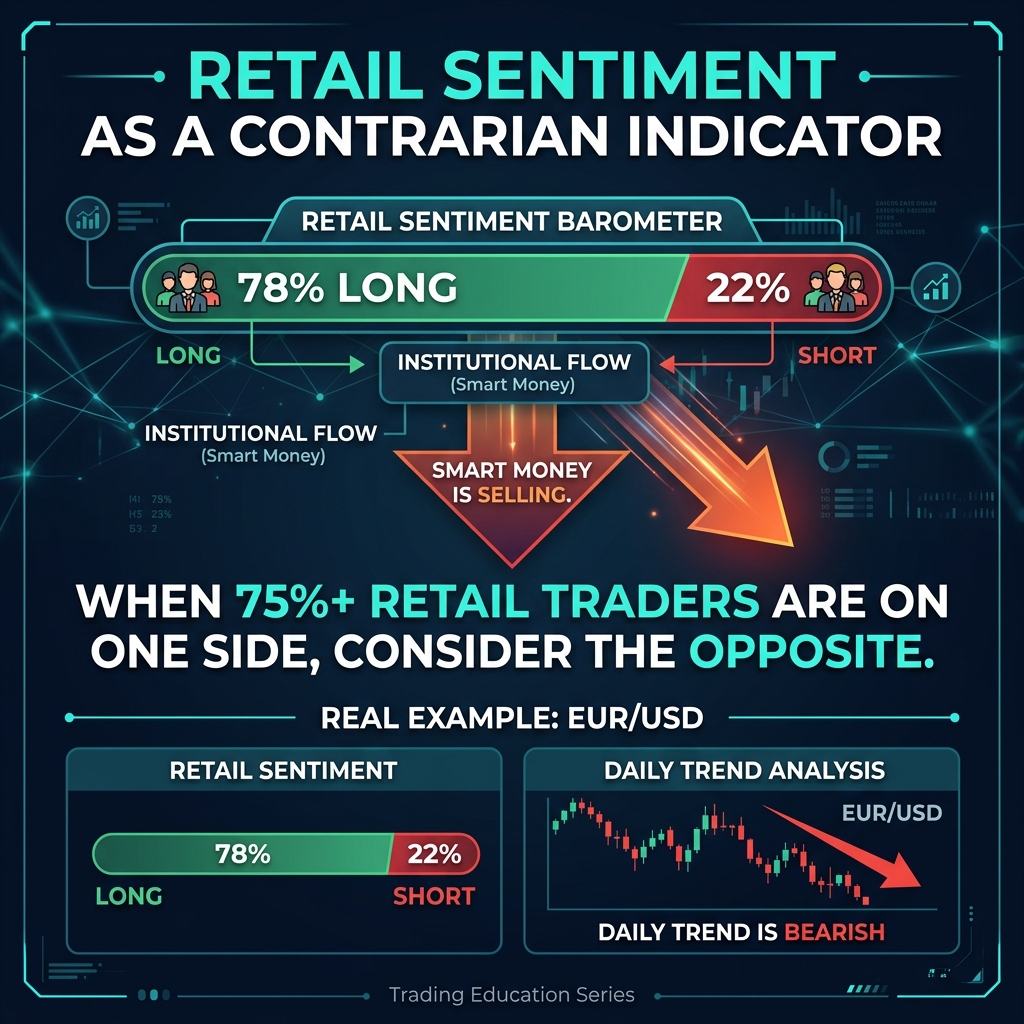
When 90% of traders are bullish, who's left to buy? No one. That's when the reversal begins. Market sentiment is the hidden layer that most retail traders ignore — and it's exactly why they're consistently on the wrong side of major moves.
What Is Market Sentiment?
Market sentiment is the overall attitude or mood of market participants toward a specific currency or market. It answers one question: are traders collectively bullish or bearish right now?
- Bullish sentiment: Majority of traders expect prices to rise → they're buying
- Bearish sentiment: Majority of traders expect prices to fall → they're selling
- Extreme sentiment: When the crowd overwhelmingly leans one way → high probability of reversal
Tools to Measure Sentiment
| Tool | What It Shows | Where to Find It |
|---|---|---|
| Retail Positioning Data | % of retail traders long vs short on a pair | Your broker's platform (IG, OANDA, etc.) |
| COT Report | Positioning of institutional traders (big money) | CFTC.gov (free, released weekly) |
| Fear & Greed Index | Overall market mood (extreme fear to extreme greed) | CNN Business (stocks, but useful for risk sentiment) |
| VIX (Volatility Index) | Market fear gauge — high VIX = fear, low VIX = complacency | TradingView, any financial site |
| Social Media / News Tone | Qualitative — what's the narrative? Is everyone screaming "buy"? | Twitter/X, ForexFactory forums, financial media |
Retail Positioning — The Crowd Is Usually Wrong
Here's a harsh truth: retail traders lose money at a rate of 70-80%. This means their collective positioning is, on average, wrong. Many brokers publish this data — and smart traders use it as a contrarian indicator.
How to Read Retail Positioning
| Retail Position | What It Means | Contrarian Action |
|---|---|---|
| 70%+ Long | Crowd is aggressively bullish | Look for short opportunities |
| 70%+ Short | Crowd is aggressively bearish | Look for long opportunities |
| 50-60% either way | No clear crowd bias | Sentiment is neutral — rely on technicals |
Real example: If 78% of retail traders are long EUR/USD but the Daily chart shows a clear downtrend — this is a powerful sell signal. The crowd is fighting the trend and will eventually be forced out (their stop losses become fuel for the continuation).
Risk Sentiment — Risk-On vs Risk-Off
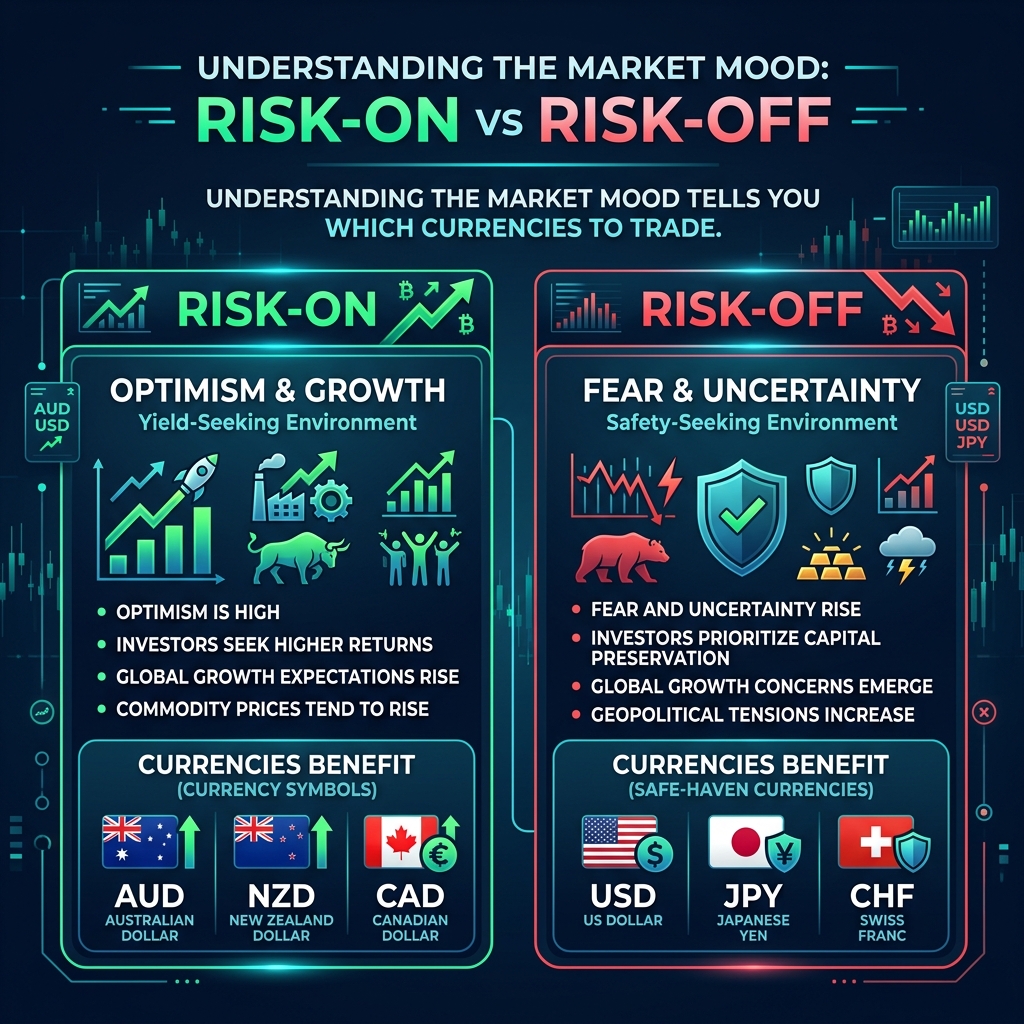
Beyond individual pair sentiment, there's a broader market mood that affects all currencies:
| Environment | What It Means | Currencies That Benefit |
|---|---|---|
| Risk-On | Optimism, growth expectations, appetite for yield | AUD, NZD, CAD (commodity/growth currencies) |
| Risk-Off | Fear, uncertainty, flight to safety | USD, JPY, CHF (safe haven currencies) |
During geopolitical crises, pandemics, or financial instability → risk-off → JPY and CHF strengthen. During economic booms and positive data → risk-on → AUD and NZD strengthen.
Quick Recap
- Sentiment analysis tells you what the crowd expects — and the crowd is often wrong at extremes
- Retail positioning data is a powerful contrarian indicator — when 70%+ are one side, consider the opposite
- Key tools: COT Report, retail positioning, VIX, Fear & Greed index
- Understand risk-on vs risk-off environments to know which currencies are in favor
- Sentiment is a filter, not a standalone signal — combine with technical and fundamental analysis
🎯 Your Action Step
Check your broker's sentiment page (most brokers show % long vs short for major pairs). Find any pair where sentiment is 70%+ one direction. Then look at the Daily chart — is the crowd trading with or against the trend? Note: "EUR/USD: 75% long, but Daily trend is DOWN, EMA points south." This tells you the crowd is wrong and a continuation lower is likely. Track this for 5 pairs over 2 weeks.