The Invisible Hand That Moves Every Pair
Here's a truth that will save you thousands: every major currency move in the last 50 years started with an interest rate decision. Not a chart pattern. Not a candlestick signal. An interest rate decision by a central bank.
You can master every indicator in existence, but if you don't understand how interest rates drive currency flows, you're trading blind. This lesson shows you exactly why — and how to use this knowledge to stay on the right side of the trade.
What Are Interest Rates (and Why Should You Care)?
An interest rate is the cost of borrowing money — or the reward for saving it. Central banks (like the Fed, ECB, or BoJ) set a benchmark rate that influences every other rate in the economy: mortgages, loans, savings accounts, and most importantly for you — currency valuations.
When a central bank raises rates, it's saying: "Our economy is strong enough to handle more expensive money." When it cuts rates, it's saying: "We need to stimulate growth — make borrowing cheaper."
| Action | What It Signals | Effect on Currency |
|---|---|---|
| Rate Hike ↑ | Strong economy, inflation concern | Currency strengthens ↑ |
| Rate Cut ↓ | Weak economy, needs stimulus | Currency weakens ↓ |
| Rate Hold → | Wait and see | Depends on expectations |
The Mechanism: How Rates Actually Move Currencies
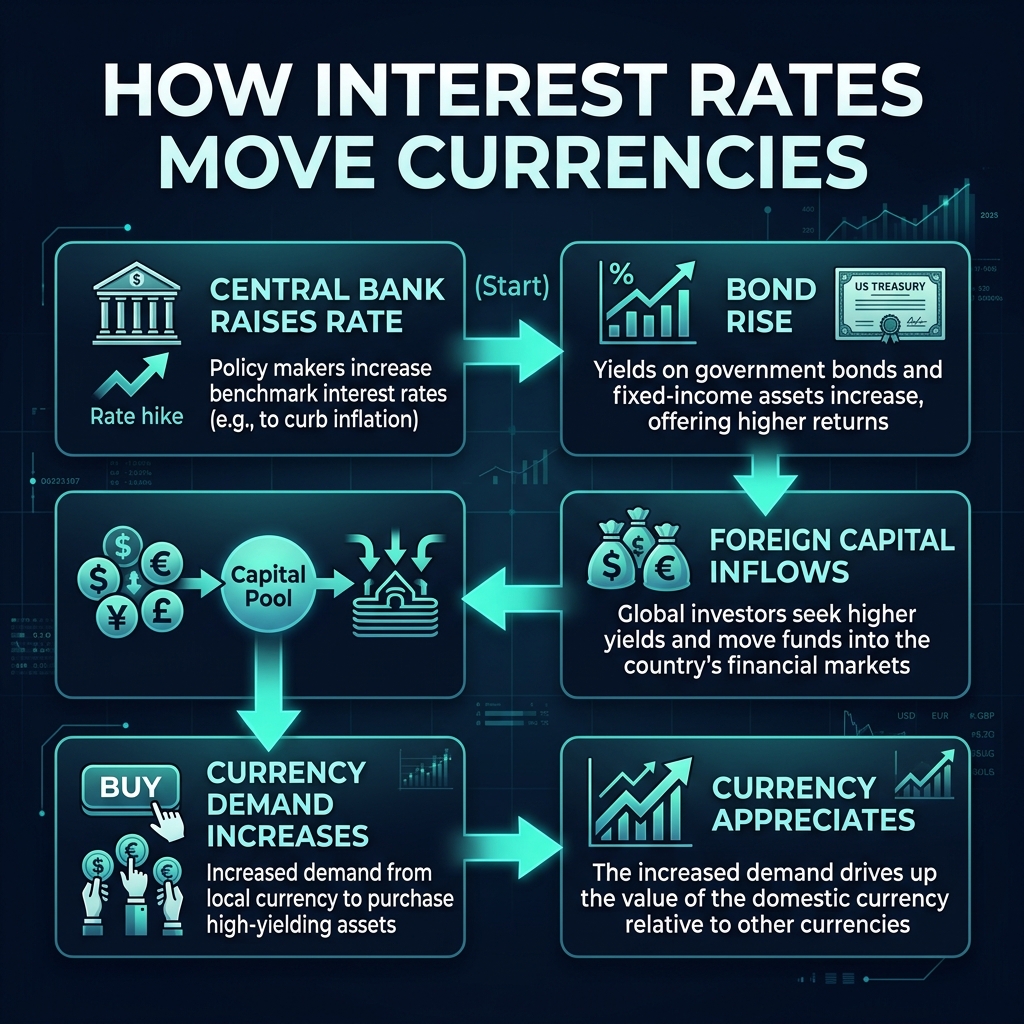
The connection between interest rates and currencies works through one powerful concept: capital flows follow yield.
Imagine you're an institutional investor managing $500 million. Country A offers 5% return on government bonds. Country B offers 1%. Where do you park your money? You buy Country A's bonds — which means you need to buy Country A's currency first. Multiply this decision by thousands of institutions worldwide, and you have a massive demand increase for Country A's currency.
The Chain Reaction
- Central bank raises interest rates
- Government bond yields increase
- International investors buy those bonds for higher returns
- They must buy the domestic currency to purchase bonds
- Increased demand for currency → currency appreciates
This is why USD strengthens when the Fed raises rates — global capital floods into dollar-denominated assets for the better yield.
It's Not Just the Rate — It's the Expectation
Here's where most traders get blindsided: the market moves on expectations, not announcements. By the time the Fed actually raises rates, the move has already happened. The market priced it in weeks or months ago.
What actually moves the market? Surprises.
| Market Expected | Actual Result | Currency Impact |
|---|---|---|
| Rate hike (0.25%) | Rate hold (0%) | Currency drops sharply ↓ |
| Rate hold | Surprise rate hike | Currency spikes ↑ |
| Rate cut (0.25%) | Bigger cut (0.50%) | Currency crashes ↓↓ |
| Rate hike (0.25%) | Rate hike (0.25%) | Already priced in — flat or "sell the news" |
Takeaway: Don't just track what central banks do — track what the market expects them to do. The gap between expectation and reality is where the money is.
Interest Rate Differentials — The Carry Trade Edge
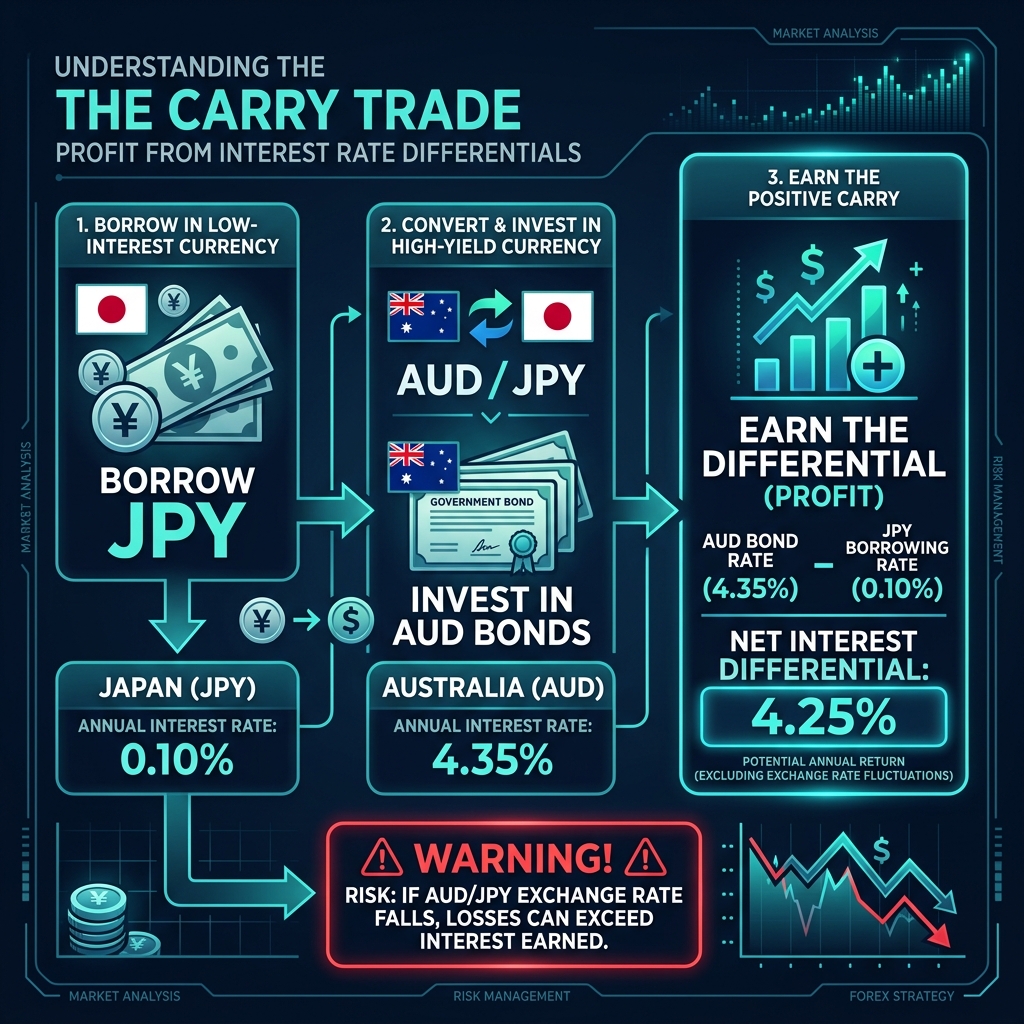
You don't just look at one country's rate — you compare two. The interest rate differential between two currencies in a pair is the core driver of long-term trends.
Real Example: AUD/JPY
- Australia: 4.35% rate (higher yield)
- Japan: 0.10% rate (near-zero yield)
- Differential: +4.25% in favor of AUD
If you go long AUD/JPY, you're buying the higher-yielding currency and selling the lower-yielding one. You earn the rate differential daily as swap/rollover. This is the famous carry trade — and it's how institutional traders make money just by holding positions.
Warning: Carry trades work beautifully in calm markets — but when risk sentiment shifts (crisis, panic), the lower-yield "safe haven" currencies (JPY, CHF) spike and carry trades unwind violently.
How to Trade Interest Rate Decisions
Before the Decision (Preparation)
- Check market expectations: Use the CME FedWatch Tool (for Fed) or similar tools for other central banks
- Read economic indicators: CPI, employment data, GDP — these hint at the decision
- Know the schedule: Mark every central bank meeting on your calendar
During the Decision (Execution)
- Spreads widen massively — don't enter right at announcement
- Wait for the initial spike to settle (5-15 minutes minimum)
- Watch the statement/press conference — forward guidance moves markets more than the decision itself
After the Decision (Follow-Through)
- If dovish (cutting rates / signaling more cuts) → look for short setups on that currency
- If hawkish (raising rates / signaling more hikes) → look for long setups
- The trend from a rate shift can last weeks to months
Quick Recap
- Interest rates are the #1 fundamental driver of currency prices
- Higher rates → stronger currency (capital flows follow yield)
- What matters most is the surprise — the gap between expectation and reality
- Interest rate differentials drive carry trades and long-term trends
- Always check forward guidance — the statement matters more than the rate itself
- Never trade the announcement directly — wait for the volatility to settle
🎯 Your Action Step
Open the CME FedWatch Tool (free). Look at the probability of the next Fed rate decision. Then check the current rates for the BoE and ECB. Calculate the rate differential for EUR/USD and GBP/USD. Write down: "The rate differential favors [currency] in [pair] — so the long-term bias is [direction]." Compare this with what the Daily chart shows. Does the technical trend match the fundamental bias?