Two Types of Waves — Know Which One You're In
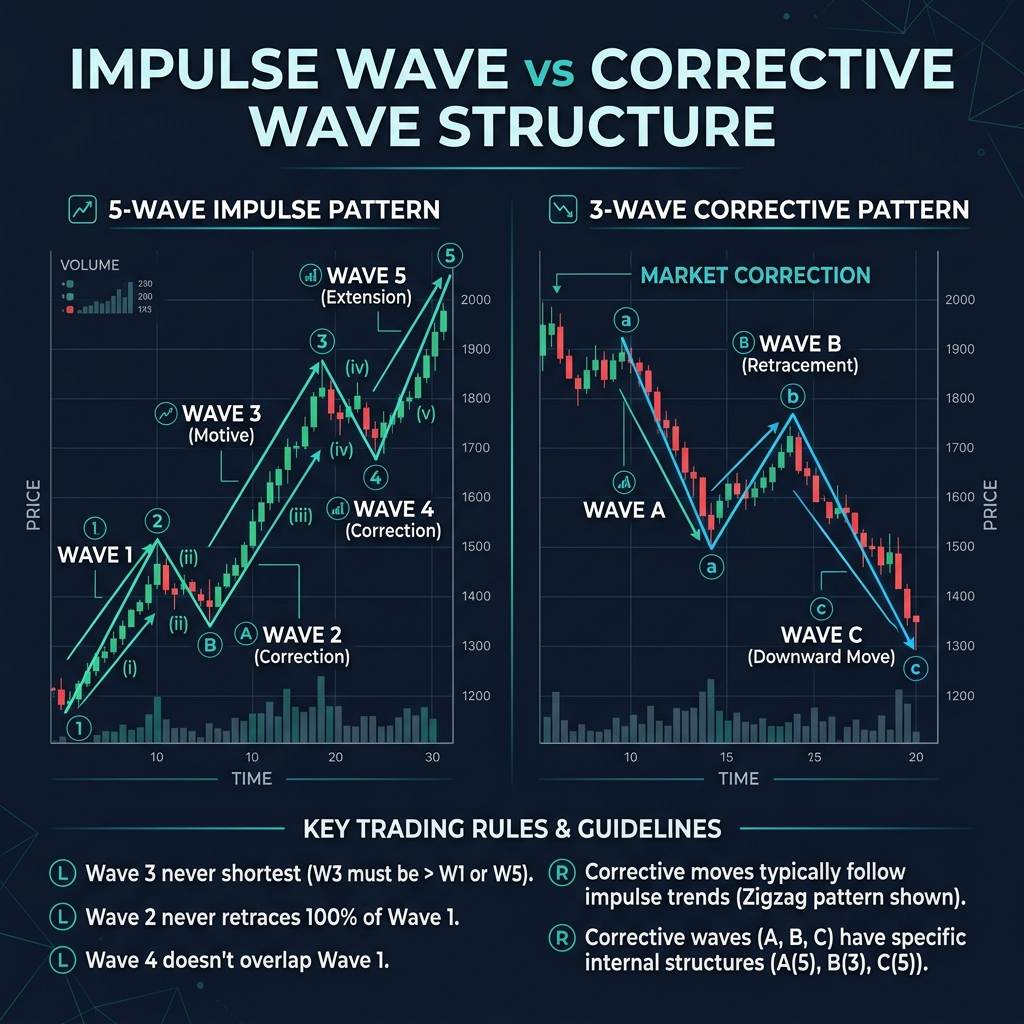
In the previous lesson, you learned the 5-3 pattern. Now here's the question that separates profitable Elliott Wave traders from confused ones: "Am I looking at an impulse move or a corrective move?" Get this wrong, and you'll trade against the trend thinking you're trading with it.
Impulse waves are powerful, directional, and tradable. Corrective waves are messy, choppy, and designed to shake you out. Knowing the difference is worth more than any indicator on your chart.
Impulse Waves — The Money-Making Moves
Impulse waves are the engine of the market. They move in the direction of the larger trend and have these characteristics:
| Feature | Impulse Wave Behavior |
|---|---|
| Structure | 5-wave internal pattern (1-2-3-4-5) |
| Direction | Moves WITH the larger trend |
| Momentum | Strong, directional, increasing volume |
| Candles | Large bodies, small wicks, clean movement |
| Duration | Faster — covers more price in less time |
| Feeling | "The market has decided" — clear, powerful |
Key insight: Within an uptrend, Waves 1, 3, and 5 are impulse waves (moving up). Within that same uptrend, Waves 2 and 4 are corrective (moving down). It's waves within waves — this is the fractal nature of markets.
Corrective Waves — The Choppy Traps
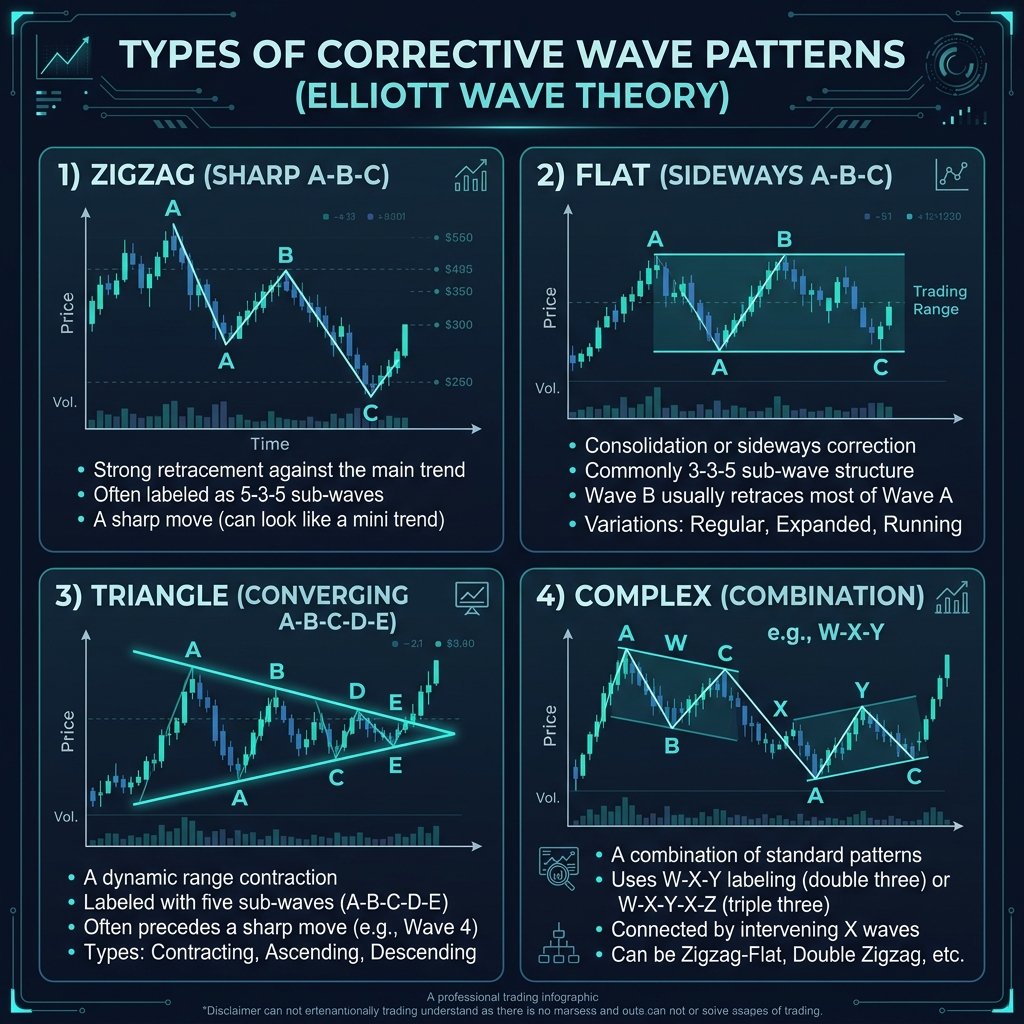
Corrective waves move against the larger trend. They're designed to shake out weak hands, frustrate traders, and make you second-guess your analysis.
| Feature | Corrective Wave Behavior |
|---|---|
| Structure | 3-wave internal pattern (A-B-C) |
| Direction | Moves AGAINST the larger trend |
| Momentum | Weak, overlapping, declining volume |
| Candles | Mixed sizes, long wicks, overlapping bodies |
| Duration | Slower — takes longer, covers less price |
| Feeling | "The market can't decide" — choppy, frustrating |
Common Corrective Patterns
Zigzag (5-3-5): The sharpest correction. A moves strongly, B retraces partially, C pushes past A. Common in Wave 2 corrections.
Flat (3-3-5): A sideways correction. A, B, and C are roughly equal. The range stays tight. Common in Wave 4 corrections.
Triangle (3-3-3-3-3): Converging correction. Price squeezes into a triangle over 5 sub-waves. Often appears in Wave 4 or Wave B. Typically breaks out in the direction of the larger trend.
How to Tell Them Apart in Real-Time
When you're staring at a live chart, use these quick checks:
| Check | Impulse | Corrective |
|---|---|---|
| Count the sub-waves | 5 clear waves | 3 overlapping waves |
| Volume | Increasing with the move | Decreasing or flat |
| Candle overlap | Minimal — clean stairs pattern | Heavy — candles keep crossing each other |
| Speed | Fast, covers ground quickly | Slow, grinds sideways |
| RSI behavior | Makes new extremes | Stays near 40-60 range |
Trading Implications
If You're in an Impulse Wave
- Trade WITH the direction — buy dips in an up impulse, sell rallies in a down impulse
- Use momentum strategies — breakouts, trend following, hidden divergence
- Let your winners run — impulse waves often go further than expected
If You're in a Corrective Wave
- Reduce position sizes — corrections are choppy and unpredictable
- Use range strategies — buy support, sell resistance within the correction
- Look for the correction to end — that's your next high-probability impulse entry
- Watch Fibonacci levels — corrections often end at 38.2%, 50%, or 61.8% retracement
Quick Recap
- Impulse waves = 5-wave, strong momentum, trades WITH trend → trade aggressively
- Corrective waves = 3-wave, weak momentum, trades AGAINST trend → trade cautiously
- Impulses are fast and clean; corrections are slow and choppy
- Three corrective patterns: zigzag, flat, triangle
- The end of a correction is your best entry for the next impulse
🎯 Your Action Step
Go back to the USD/JPY Daily chart from your last exercise. Now label the waves as either "impulse" (5-wave, strong) or "corrective" (3-wave, choppy). For each corrective wave, identify which type it is: zigzag, flat, or triangle. Notice how corrections feel different from impulses — the candles overlap more, volume drops, and the movement is slower.