Your Broker Can Make or Break You — Choose Wisely
Here's a truth most trading "gurus" skip: your broker is the foundation of your entire trading career. No matter how brilliant your strategy is, if your broker is slow, expensive, or shady — you're fighting an uphill battle before your first trade even opens.
Think of your broker like a business partner. They hold your money, execute your trades, and control the prices you see. Choose the wrong partner? You lose money even when your analysis is right.
This lesson gives you the exact checklist to evaluate any broker — no fluff, no sales pitch, just what actually matters.
The 6-Point Broker Checklist
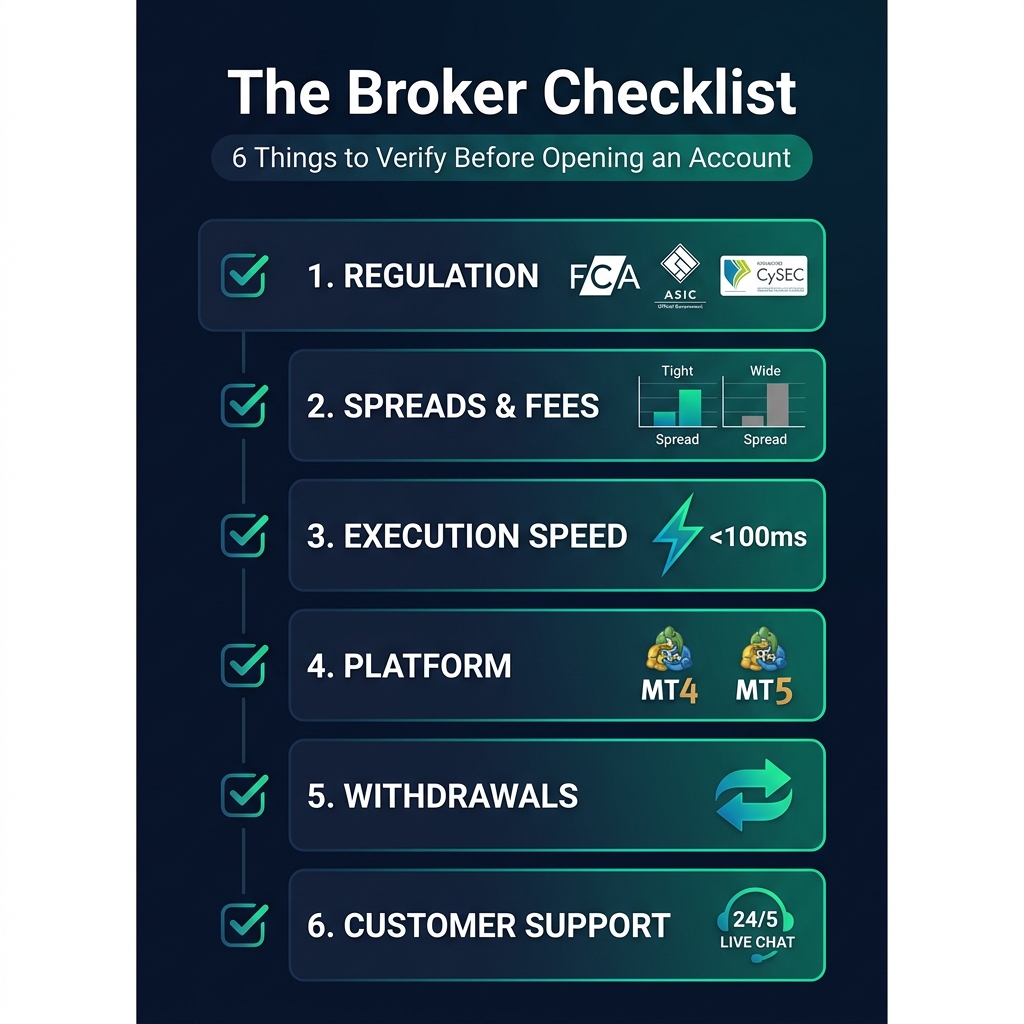
1. Regulation — The Non-Negotiable
This is rule #1, and it's non-negotiable. A regulated broker must follow strict financial rules, keep your funds in segregated accounts, and undergo regular audits.
Look for licenses from these Tier-1 regulators:
| Regulator | Region | Trust Level |
|---|---|---|
| FCA | United Kingdom | ⭐⭐⭐⭐⭐ |
| ASIC | Australia | ⭐⭐⭐⭐⭐ |
| CySEC | Europe (Cyprus) | ⭐⭐⭐⭐ |
| NFA/CFTC | United States | ⭐⭐⭐⭐⭐ |
| DFSA | Dubai (UAE) | ⭐⭐⭐⭐ |
⚠️ Pro tip: Always verify the license number on the regulator's official website — not just the broker's. Scam brokers love fake badges.
2. Trading Costs — Spreads & Commissions
Every trade you make has a cost, and that cost adds up fast. There are two pricing models:
| Model | How It Works | Best For |
|---|---|---|
| Spread-only | No commission, wider spreads | Beginners, swing traders |
| Raw spread + commission | Tight spreads + fixed fee per lot | Scalpers, active day traders |
Always check: average EUR/USD spread, commission per lot, swap/overnight fees, and any hidden charges (inactivity fees, withdrawal fees, currency conversion markups).
3. Execution Speed — Every Millisecond Counts
Slow execution causes slippage — the difference between the price you wanted and the price you actually got. For scalpers and day traders, this is a deal-breaker.
Look for:
- ECN or STP execution (sends orders directly to liquidity providers)
- Execution under 100 milliseconds
- Low latency servers or VPS availability
- Minimal requotes during volatile sessions
4. Platform — Your Daily Cockpit
Most brokers offer MetaTrader 4 (MT4), MetaTrader 5 (MT5), or cTrader. For beginners, MT4 remains the gold standard — simple, stable, and universally supported.
Consider: user interface, mobile app quality, charting tools, custom indicators, and Expert Advisor (EA) compatibility if you plan to automate.
5. Deposit & Withdrawal
A good broker makes depositing easy and withdrawing even easier. A scam broker does the opposite.
Always test with a small withdrawal first before committing large capital. Check processing times, available payment methods, and any withdrawal fees.
6. Customer Support
Try contacting support before opening an account. Fast, professional responses = reliability. Slow or scripted replies = run.
Look for 24/5 live chat, phone support, and multilingual assistance.
Good Broker vs Scam Broker — Know the Red Flags
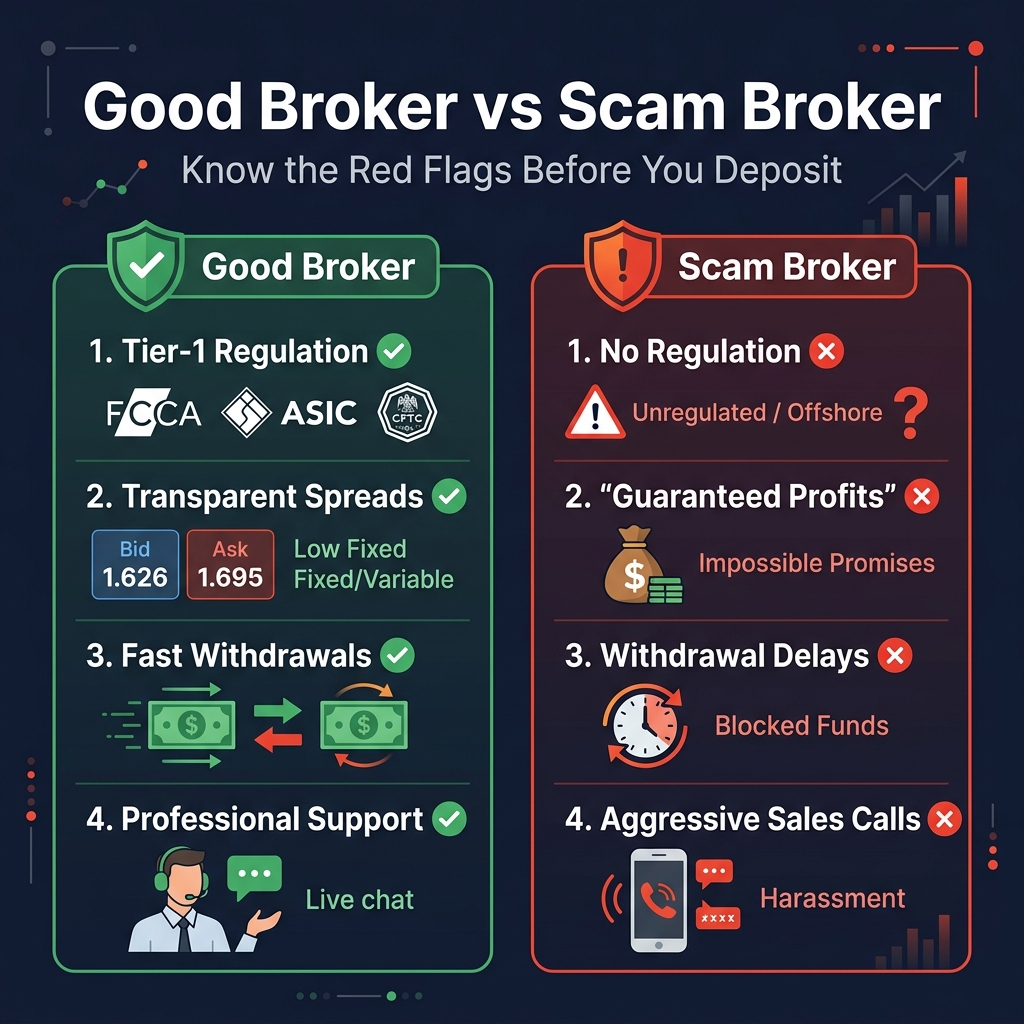
| Feature | ✅ Good Broker | ❌ Scam Broker |
|---|---|---|
| Regulation | Tier-1 licensed (FCA, ASIC) | Offshore only, unverifiable |
| Promises | Transparent risk disclosure | "Guaranteed profits" |
| Spreads | Competitive & clearly stated | Wide, unclear, changes often |
| Withdrawals | Fast, smooth (24-48 hours) | Delays, excuses, hidden fees |
| Reviews | Mostly positive on Trustpilot | Many complaints, fake reviews |
| Sales | No pressure | Aggressive calls to deposit more |
🚨 Red flag rule: If a broker promises "guaranteed profits" or pressures you to deposit — run. No legitimate broker guarantees trading outcomes.
Beginner's Priority List
If you're just starting out, here's what matters most (in order):
- Regulation — Non-negotiable. Your money's safety comes first.
- Low minimum deposit — Start small ($50-$100) while you learn.
- Demo account — Practice with virtual money before risking real funds.
- Micro lot trading — Trade small positions (0.01 lots) to manage risk.
- Negative balance protection — Ensures you can't lose more than your deposit.
- Educational resources — Built-in learning materials help you grow faster.
The best broker for beginners isn't the one with the highest leverage or flashiest website — it's the one that protects you while you learn.
What About Leverage?
Leverage is tempting, but for beginners, less is more:
| Leverage | Who It's For | Risk Level |
|---|---|---|
| 1:30 | EU regulated, safest | 🟢 Low |
| 1:50 - 1:100 | Most retail traders | 🟡 Medium |
| 1:200 - 1:500 | Experienced traders | 🔴 High |
| 1:1000+ | Extreme risk takers | 🔴🔴 Very High |
Start with 1:30 or 1:50. You can always increase later once you understand how leverage amplifies both gains and losses.
Quick Recap
- ✅ Regulation is #1 — Always verify on the regulator's official website
- ✅ Compare real costs — Spreads + commissions + hidden fees
- ✅ Test withdrawals — Before depositing large amounts
- ✅ Avoid red flags — "Guaranteed profits" = guaranteed scam
- ✅ Start conservative — Low leverage, low deposit, micro lots
- ✅ Use a demo first — Every good broker offers one
🎯 Your Action Step
Before your next lesson, do this: pick any 3 brokers you've heard of. Look up their regulation, check their spreads on EUR/USD, and read 5 real user reviews on Trustpilot. How do they compare?
This 15-minute exercise could save you thousands of dollars and months of frustration.