Three Numbers That Predict Every Central Bank Decision
Central banks don't make decisions in a vacuum. They watch three key economic indicators obsessively — and so should you. If you can read these three numbers, you can predict what a central bank will do before they announce it. That's not speculation — that's fundamental analysis.
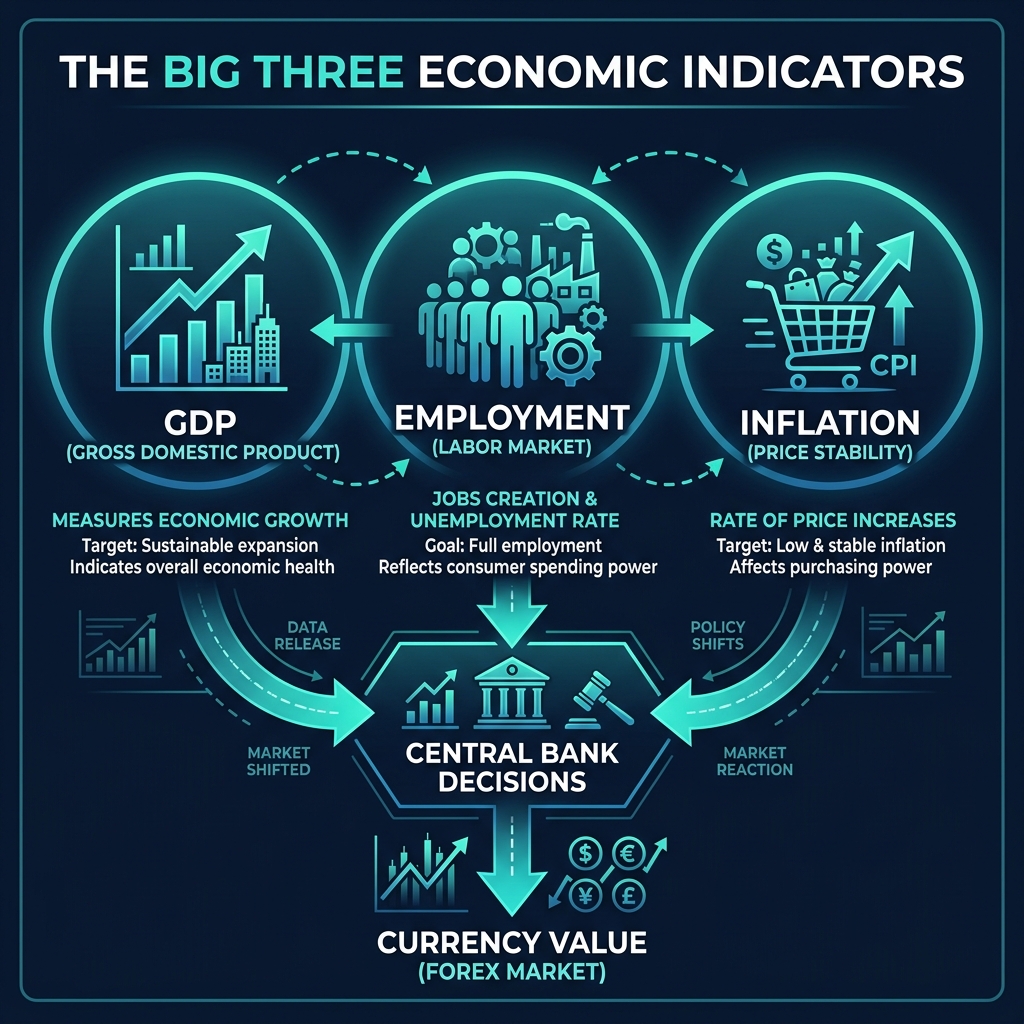
The Big Three: GDP (growth), Employment (jobs), and Inflation (prices). Master these and you'll understand why currencies move — not just when.
GDP — Is the Economy Growing or Shrinking?
Gross Domestic Product (GDP) measures the total value of everything a country produces — goods, services, everything. It's the ultimate scorecard for an economy's health.
What GDP Tells You About a Currency
| GDP Result | What It Signals | Central Bank Response | Currency Impact |
|---|---|---|---|
| Growth above expectations | Economy booming | May raise rates to prevent overheating | Bullish ↑ |
| Growth at expectations | Economy stable | Likely hold rates steady | Neutral → |
| Growth below expectations | Economy slowing | May cut rates to stimulate growth | Bearish ↓ |
| Negative GDP (2 quarters) | Recession | Emergency rate cuts likely | Strongly bearish ↓↓ |
How to Trade It
- GDP is released quarterly (3 readings: advance, preliminary, final)
- The advance reading has the most market impact — it's the first look
- Focus on the gap between actual vs forecast, not the absolute number
Employment — The Pulse of Economic Health
Jobs data is the most watched economic indicator in forex. Why? Because employment directly affects consumer spending — and consumer spending drives 70% of the U.S. economy.
Key Employment Reports
| Report | Country | Release | Why It Matters |
|---|---|---|---|
| Non-Farm Payrolls (NFP) | USA | First Friday of each month | The single most market-moving data release in forex |
| Unemployment Rate | USA | Same day as NFP | Shows labor market health |
| Average Hourly Earnings | USA | Same day as NFP | Wage inflation — the Fed watches this closely |
| Employment Change | Canada/Australia | Monthly | Moves CAD and AUD |
| Claimant Count Change | UK | Monthly | Unemployment claims — moves GBP |
NFP — The King of Market Movers
Non-Farm Payrolls reports how many jobs were added or lost in the U.S. economy (excluding farms). A typical NFP day can move USD pairs 50-150 pips within minutes.
- Strong NFP (more jobs than expected) → USD strengthens (hawkish Fed)
- Weak NFP (fewer jobs than expected) → USD weakens (dovish Fed)
- Pro tip: Also watch wage growth — rising wages mean inflation pressure, which is even more important than the jobs count itself
Inflation — The Silent Currency Killer
Inflation measures how fast prices are rising. A little inflation (around 2%) is healthy. Too much (5%+) is destructive. Central banks exist primarily to control inflation — every rate decision is ultimately an inflation decision.
Key Inflation Reports
| Report | What It Measures | Why It Matters |
|---|---|---|
| CPI (Consumer Price Index) | Price changes for consumer goods/services | The primary inflation measure — drives rate expectations |
| Core CPI | CPI excluding food and energy | More stable — shows underlying inflation trends |
| PCE (Personal Consumption Expenditures) | Broader price measure | The Fed's PREFERRED inflation gauge |
| PPI (Producer Price Index) | Input costs for producers | Leading indicator — producer costs pass through to consumers |
The Inflation-Rate Decision Connection
- CPI rising above target → Central bank likely to raise rates → currency strengthens
- CPI falling below target → Central bank likely to cut rates → currency weakens
- Pro tip: Core CPI matters more than headline CPI because it strips out volatile food and energy prices
Putting It All Together — The Fundamental Playbook
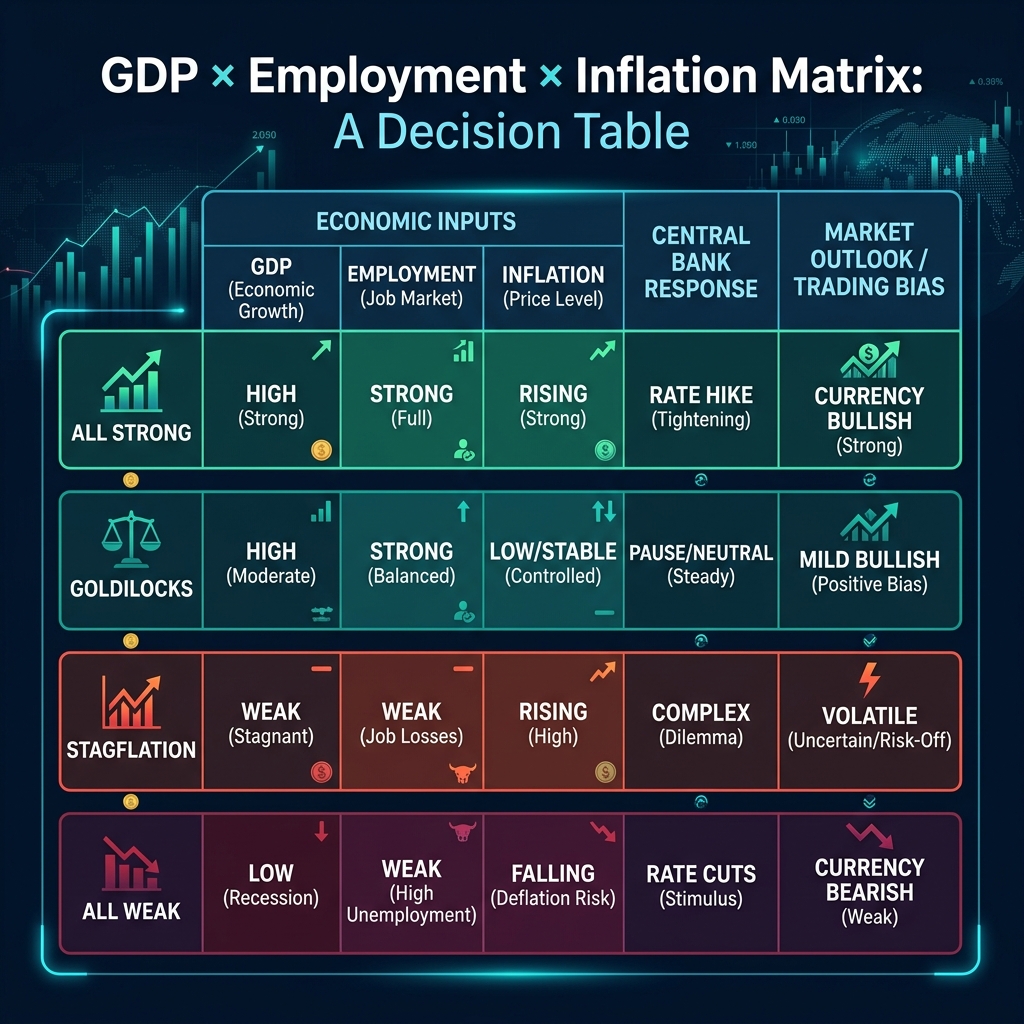
These three indicators work together to paint a picture of economic health. Here's how to read the combinations:
| GDP | Employment | Inflation | Central Bank Likely Action | Currency Bias |
|---|---|---|---|---|
| Strong ↑ | Strong ↑ | Rising ↑ | Rate hike | Strongly bullish ↑↑ |
| Strong ↑ | Strong ↑ | Low ↓ | Hold — Goldilocks scenario | Mildly bullish ↑ |
| Weak ↓ | Weak ↓ | Rising ↑ | Stagflation — worst case — unclear | Volatile, uncertain |
| Weak ↓ | Weak ↓ | Low ↓ | Rate cuts, QE | Strongly bearish ↓↓ |
Quick Recap
- GDP tells you if the economy is growing — strong GDP = hawkish central bank = strong currency
- Employment (NFP) is the most market-moving release — focus on actual vs forecast, and watch wage growth
- Inflation (CPI/PCE) drives rate decisions — rising inflation = rate hikes = currency strength
- Read these three indicators together to predict central bank actions
- Always compare actual vs consensus forecast — the surprise is what moves the market
🎯 Your Action Step
Go to ForexFactory.com and filter the economic calendar for "High Impact" events only. For the next week, note the GDP, Employment, and Inflation releases for USD, EUR, and GBP. Before each release, write down the forecast number. After the release, compare actual vs forecast and watch how the currency reacted. Do this for 4 consecutive weeks — you'll start seeing the patterns.