The Silent Killer of Trading Success
You’re watching your screen. A currency pair starts to move. It’s climbing fast. You weren't in the trade. "I missed it," you think. You watch it climb higher. "Look at how much money I could have made."
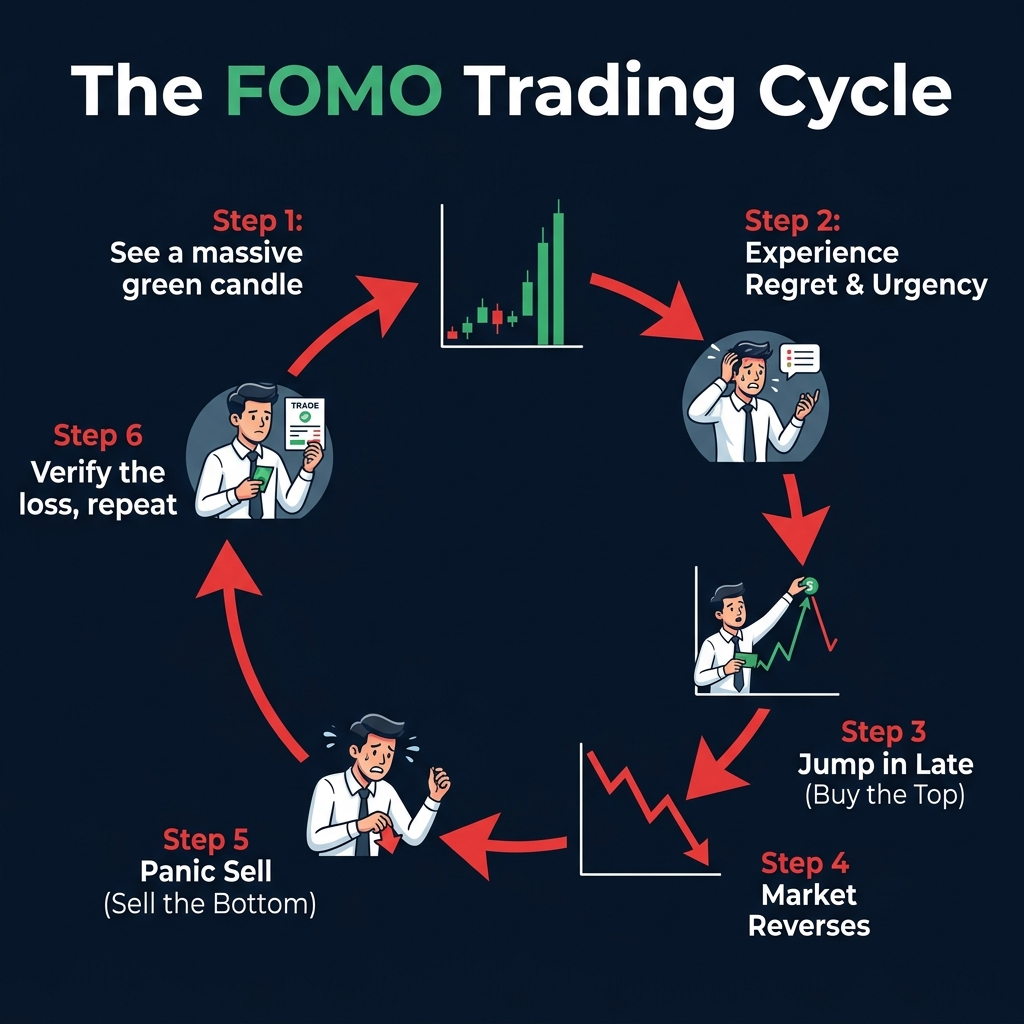
Your heart pounds, your palms sweat. The urge becomes irresistible. You throw your trading plan out the window and hit the "Buy" button at market price just to get in on the action.
Congratulations. You've just been hijacked by FOMO — the Fear Of Missing Out. And it is one of the deadliest, most account-destroying emotions in the trading world.
Why FOMO is So Dangerous
FOMO doesn’t just make you enter bad trades. It destroys your self-discipline, overrides your strategy, and leaves you second-guessing every decision. Unlike other emotional traps that build up over weeks, FOMO hijacks your brain in seconds.
When you act on FOMO, you inevitably do three things:
- You enter way too late: The institutions who caused the move are already taking their profits exactly when you are deciding to buy in.
- You ignore your stop-loss: Because you entered impulsively, you don't have a logical place to put a stop loss. You're trading on hope.
- You oversize your position: You feel you need to "make up" for the part of the move you already missed, so you trade double your normal lot size.
This is why traders acting on FOMO lose the vast majority of the time. The market is transferring wealth from the impatient (you) to the patient (the professionals).
FOMO vs Patience: The Split Screen
Let's look at how an amateur and a professional handle the exact same scenario of a rapidly moving market.
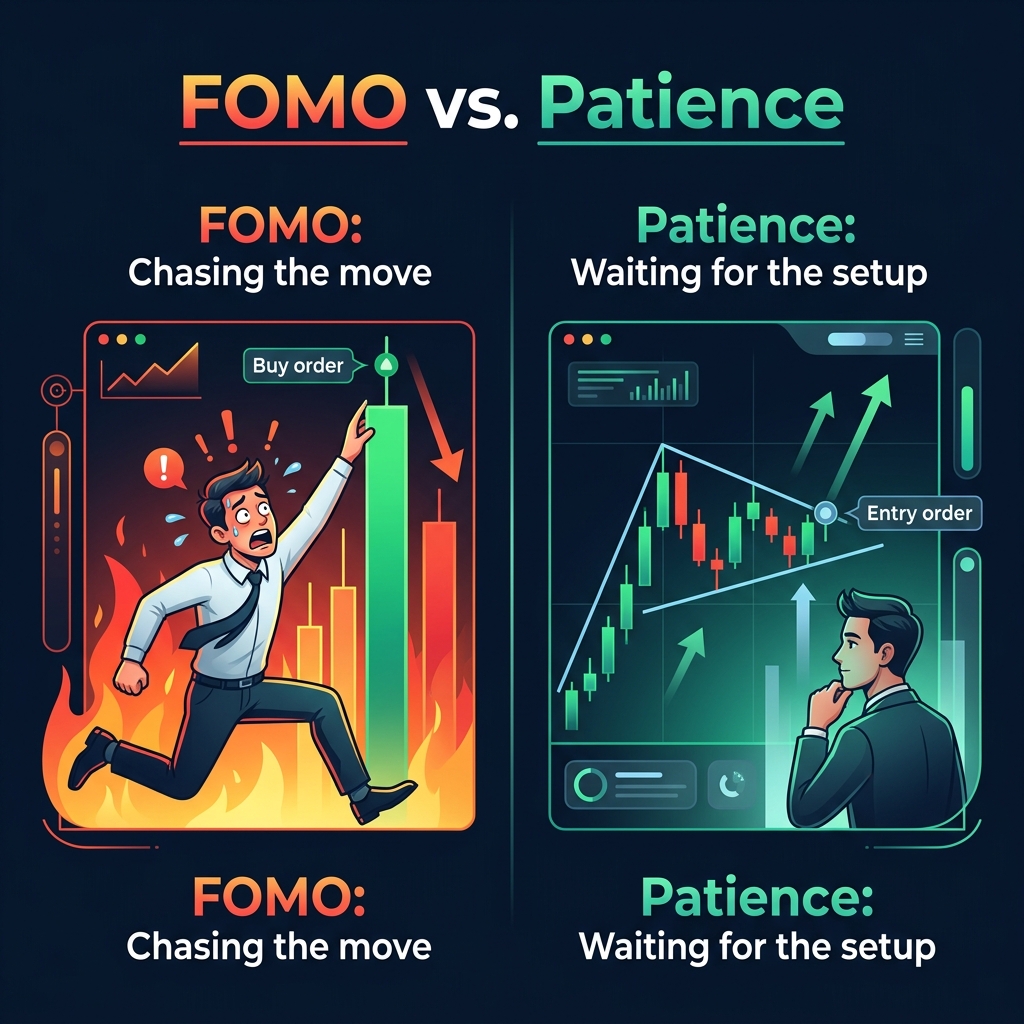
The FOMO trader jumps onto the moving train, terrified of being left behind. The train immediately derails (pulls back), stopping them out for a massive loss.
The disciplined trader watches the exact same train leave the station. They feel a slight pang of regret, but they acknowledge it and wait. They know that markets move in waves. They wait for the inevitable pullback to a support level, verify their entry criteria, and enter safely with a tight stop loss.
The Real Cost of FOMO (The Calculus of Ruin)
According to research, retail traders driven by FOMO underperform disciplined traders by a massive margin. But it's not just the immediate loss that hurts — it's the momentum of that loss.
Because FOMO losses are usually large (due to bad entries and ignored stop-losses), they trigger the mathematical nightmare known as the "Recovery Trap."
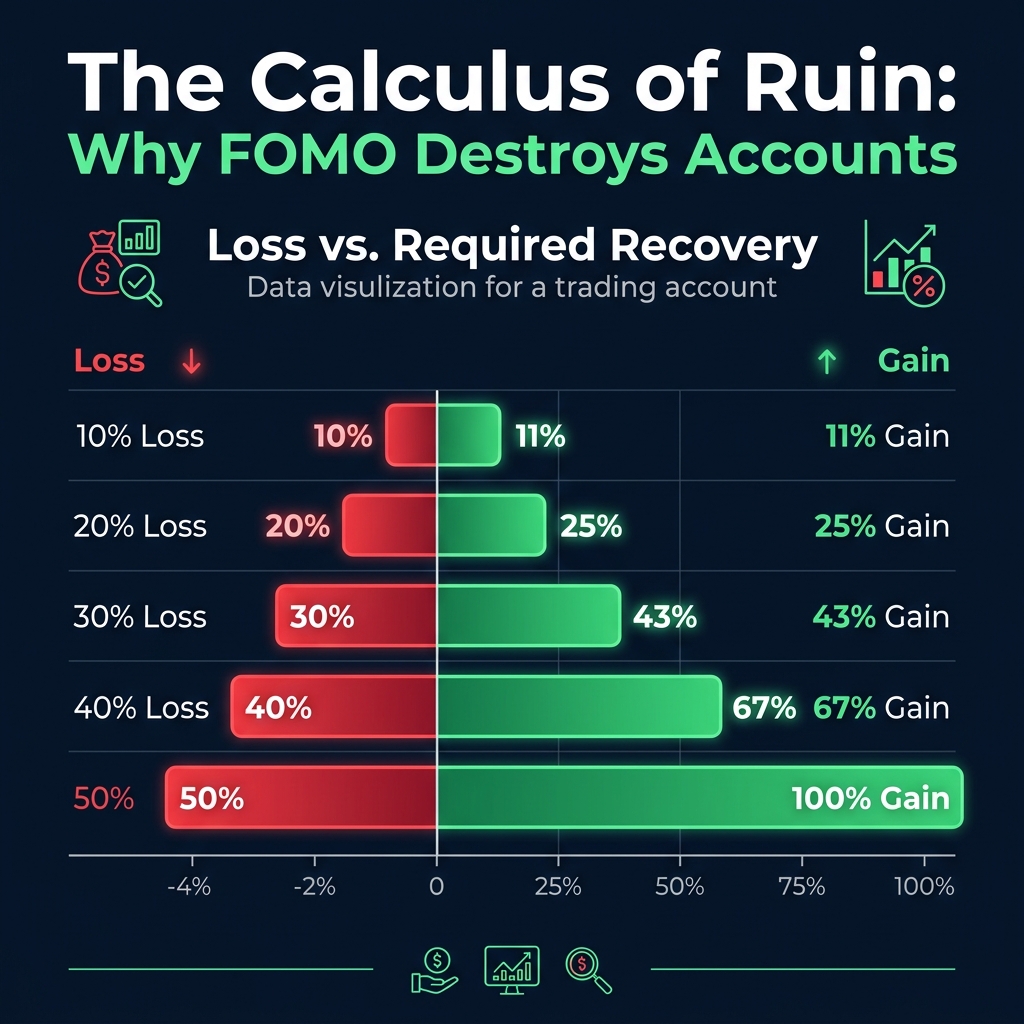
If you take a 10% loss on your account from a stupid FOMO trade, you need an 11.1% gain just to get back to breakeven. Not terrible. But if your FOMO makes you take a massive 50% loss? You now need a 100% gain just to get your money back. You have to double your account before you can make a single dollar of actual profit.
This simple math is why avoiding bad trades is often more important than finding good ones.
How to Break Free from FOMO
You can't eliminate the feeling of FOMO, but you can build systems to prevent it from controlling your hands.
1. Enforce a 5-Minute Rule
Any trade that is not on your pre-market watchlist requires a mandatory 5-minute wait before entry. Step away from the screen for 300 seconds. FOMO thrives on urgency. If you remove the urgency, the irrational impulse usually fades.
2. Reframe "Missed Trades"
Missing a trade is not a failure. Sitting in cash is a position. Your goal is not to catch every move in the market; your goal is to extract consistent profits using your specific edge. There will be another setup tomorrow, next week, and next month.
3. Mute the Noise
If seeing other traders post massive profits on Twitter, Telegram, or Instagram triggers your FOMO, unfollow them. Remember: social media is a highlight reel. You are seeing their one winning trade, not the 10 blowing-up accounts they are hiding off-screen.
🎯 Your Action Step
Create a "Watch But Don't Trade" list. The next time you feel an overwhelming urge to jump into a running market simply because you're terrified of missing out, don't click buy. Instead, write down the exact price you would have bought at. Track what happens over the next hour. You'll quickly build a folder of evidence showing that your FOMO entries almost always result in an immediate drawdown.