The Pairs That Remove USD From the Equation
Most forex traders only trade major pairs — EUR/USD, GBP/USD, USD/JPY. But there's a whole world of cross pairs that remove the US dollar from the equation entirely. EUR crosses (EUR/GBP, EUR/JPY, EUR/AUD) let you trade pure European sentiment versus other economies — without USD noise.

This lesson shows you when EUR crosses offer better trades than majors, how each cross behaves, and the key themes that drive them.
What Are Currency Crosses?
A cross pair (or "cross") is any currency pair that does NOT include the US dollar. Examples: EUR/GBP, GBP/JPY, AUD/NZD, EUR/AUD.
Why Trade Crosses?
- Pure relative value: When you trade EUR/GBP, you're betting on the Eurozone vs UK — no USD distortion
- Cleaner technicals: Sometimes majors are messy because the dollar is doing something weird. Crosses can trend more cleanly
- More opportunities: There are dozens of crosses, giving you more setups when majors are flat
- Central bank divergence plays: When ECB and BoE are on different paths, EUR/GBP trends beautifully
EUR/GBP — The European Sibling Rivalry
| Characteristic | Detail |
|---|---|
| What it measures | Euro strength vs British pound strength |
| Key driver | ECB vs BoE interest rate differential |
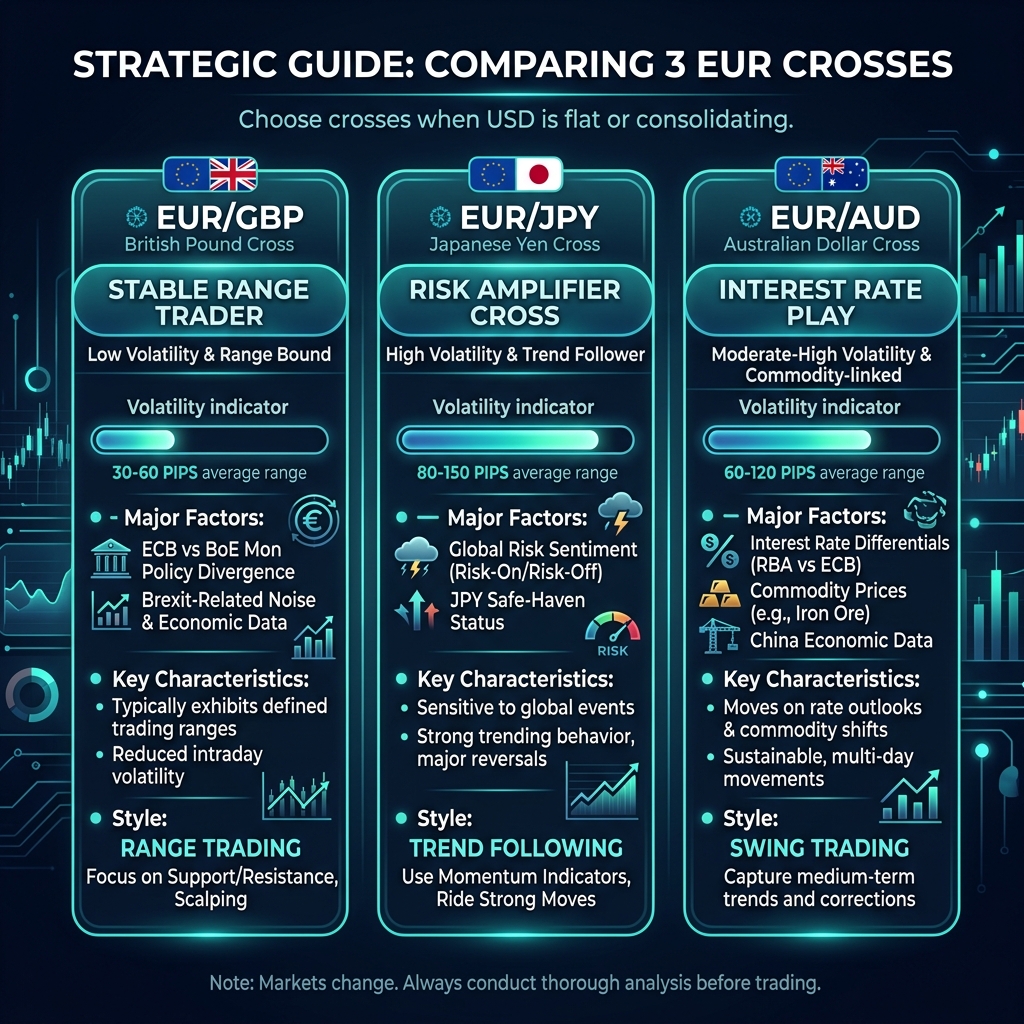
| Behavior | Tends to range in tight channels. Breaks out on policy divergence. |
| Best strategy | Range trading with breakout entries on central bank news |
| Typical daily range | 30-60 pips — smaller than majors |
| When to trade | London session (both economies active) |
Pro tip: EUR/GBP is excellent for position trades around ECB/BoE policy divergence. When one is hawkish and the other dovish, EUR/GBP trends for weeks.
EUR/JPY — The Risk Sentiment Amplifier
| Characteristic | Detail |
|---|---|
| What it measures | European growth/risk appetite vs Japanese safety |
| Key driver | Global risk sentiment + ECB/BoJ policy gap |
| Behavior | Very volatile. Huge swings on risk events. Amplifies moves. |
| Best strategy | Trend following during strong risk-on or risk-off phases |
| Typical daily range | 80-150 pips — much larger than EUR/GBP |
| When to trade | London-Tokyo overlap and NY session |
Warning: EUR/JPY can move 200+ pips in a single day during major risk events. Use wider stops and smaller position sizes.
EUR/AUD — The Rate Differential Play
| Characteristic | Detail |
|---|---|
| What it measures | Eurozone vs Australian economy (trade, rates, commodities) |
| Key driver | ECB vs RBA rate differential + commodity prices (iron ore, copper) |
| Behavior | Strongly trending — tends to make big directional moves |
| Best strategy | Swing trading on daily/H4 with trend filters |
| Typical daily range | 60-120 pips |
| When to trade | Asian session open and London session |
Pro tip: When iron ore and copper are rising (China demand), AUD strengthens and EUR/AUD tends to fall. ASX and China PMI data can front-run this pair.
When to Choose a Cross Over a Major
- When USD is ranging: If DXY is flat, majors will chop. Look at crosses for clean trends.
- When two central banks diverge: ECB hiking while BoE pausing? EUR/GBP will trend better than EUR/USD.
- When you want a pure macro trade: Trading EUR/GBP is betting on UK vs Eurozone, period. No USD noise.
- When your major setup has weak confirmation: Sometimes EUR/JPY shows a cleaner pattern than EUR/USD for the same EUR view.
Quick Recap
- Cross pairs remove USD noise — they measure pure relative value between two economies
- EUR/GBP: Tight range, best for range/divergence plays on ECB vs BoE policy
- EUR/JPY: High volatility risk sentiment amplifier — bigger moves, bigger risk
- EUR/AUD: Strong trending pair driven by rate differentials and commodity prices
- Trade crosses when USD is flat or when two non-USD central banks are diverging
- Always adjust position size for the higher volatility of some crosses
🎯 Your Action Step
Pull up EUR/GBP, EUR/JPY, and EUR/AUD on daily charts. Compare which one is trending the cleanest right now vs EUR/USD. Often, one of the crosses will have a much cleaner technical setup. If you find one, consider trading that cross instead of the dollar-based pair.