The Secret Your Broker Hopes You Never Google
When you hit "Buy" on your trading platform, where does your order actually go? Most traders never ask this question — and brokers prefer it that way.
Not all brokers work the same way. Some send your order directly to the market. Others take the opposite side of your trade — meaning when you lose, they profit. Sounds like a conflict of interest? It can be.
Understanding execution models isn't just technical jargon — it directly affects your spreads, execution speed, and whether your broker has a reason to want you to lose.
The Three Execution Models
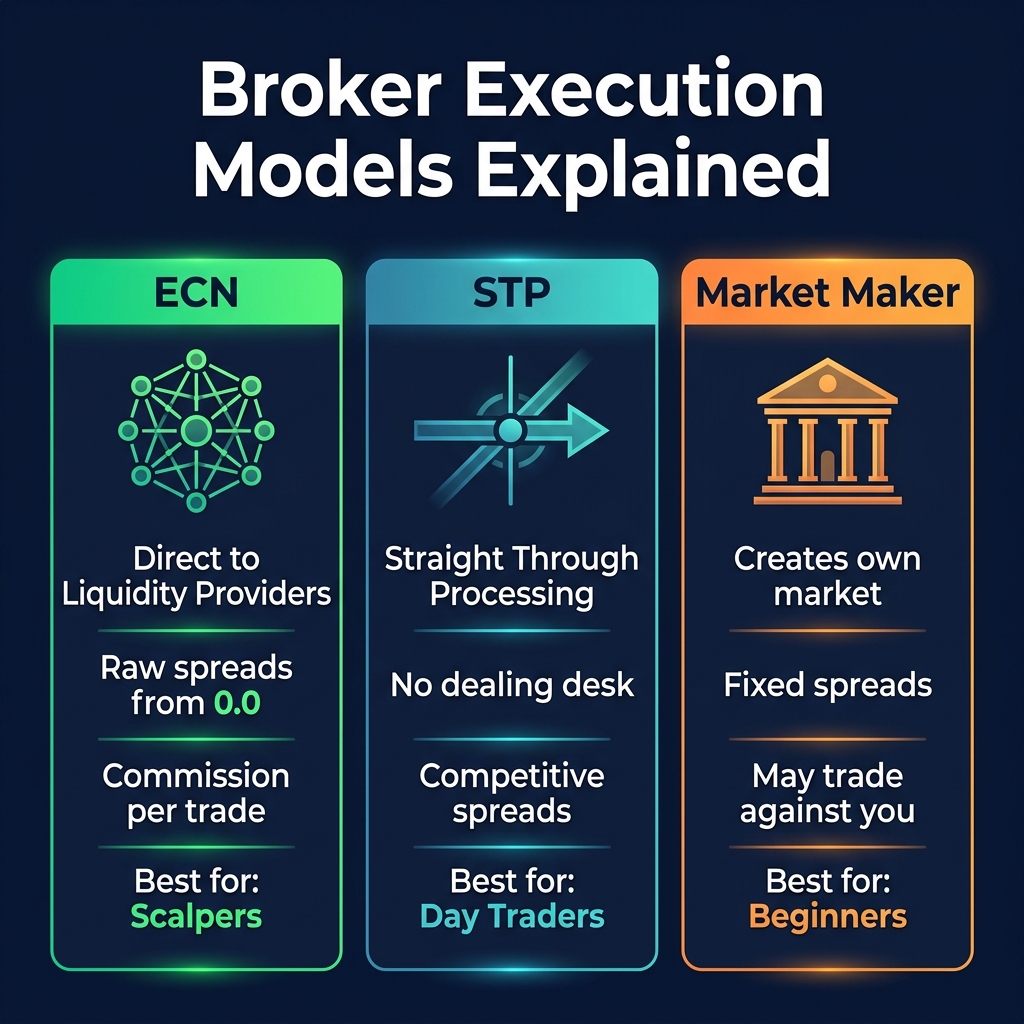
ECN (Electronic Communication Network)
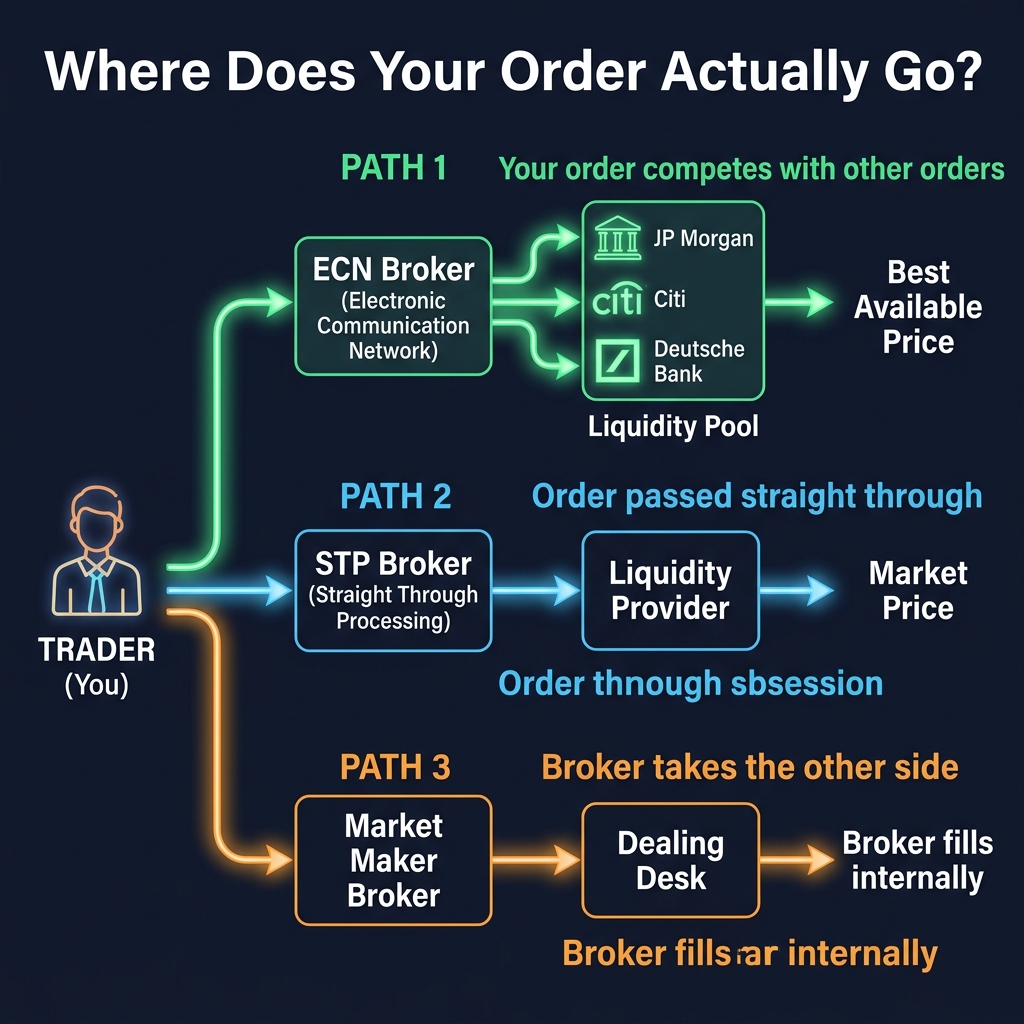
An ECN broker connects you directly to a liquidity pool made up of banks, hedge funds, and other traders. Your order competes with everyone else's for the best available price.
- Spreads: Raw spreads from 0.0 pips (can be as low as 0.0-0.2 on EUR/USD)
- Fees: Commission charged per lot (typically $3-7 per side)
- Execution: Fastest — no dealing desk, no requotes
- Best for: Scalpers, high-frequency traders, professionals
💡 Key advantage: ECN brokers have zero conflict of interest — they make money from commissions regardless of whether you win or lose.
STP (Straight Through Processing)
An STP broker passes your order straight through to their liquidity providers — no dealing desk interference. The broker adds a small markup to the spread and that's their profit.
- Spreads: Slightly wider than ECN (typically 0.5-1.5 pips on EUR/USD)
- Fees: Usually no commission — the spread IS the fee
- Execution: Fast, reliable, no dealing desk
- Best for: Day traders, swing traders, most retail traders
STP is the sweet spot for most traders — good execution, simple pricing, no commission math.
Market Maker (Dealing Desk)
A Market Maker creates its own internal market. When you buy EUR/USD, the broker takes the other side of your trade. They're essentially betting against you.
- Spreads: Fixed or semi-fixed (typically 1.5-3.0 pips on EUR/USD)
- Fees: No commission — wider spreads cover costs
- Execution: May re-quote during high volatility
- Best for: Absolute beginners who want predictable costs
⚠️ The controversy: Because Market Makers profit when you lose, there's an inherent conflict of interest. Not all Market Makers are bad — many large, regulated ones manage risk professionally. But the model itself creates a potential bias.
Where Does Your Order Actually Go?
The Comparison Table
| Feature | ECN | STP | Market Maker |
|---|---|---|---|
| Spread type | Variable, raw | Variable, marked up | Fixed or semi-fixed |
| Commission | Yes ($3-7/lot) | Usually no | No |
| Dealing desk | No | No | Yes |
| Execution speed | Fastest | Fast | Can be slower |
| Conflict of interest | None | Minimal | Potential |
| Best for | Scalpers, pros | Most traders | Beginners |
| Min deposit | Higher ($500+) | Medium ($100+) | Low ($10+) |
The Hybrid Reality
Here's what most "ECN vs Market Maker" articles won't tell you: many brokers are hybrid. They use ECN/STP for large orders and internalize smaller ones. This is completely normal and often regulated.
What matters isn't the label — it's the behavior:
- Are spreads transparent and competitive?
- Is execution fast without requotes?
- Can you withdraw money without hassle?
- Is the broker regulated by a Tier-1 authority?
If the answer to all four is "yes," the execution model label matters less than you think.
Which Model Should You Choose?
- Scalper / HFT? → ECN. You need raw spreads and zero dealing desk interference.
- Day trader / Swing trader? → STP. Best balance of cost and execution.
- Complete beginner? → Market Maker is fine as long as it's well-regulated. Focus on learning, not micro-optimizing execution.
As you grow and your volume increases, consider upgrading to an ECN or STP account for better pricing.
Quick Recap
- ✅ ECN = Direct market access, raw spreads, commission-based
- ✅ STP = Straight-through processing, no dealing desk, spread markup
- ✅ Market Maker = Internal execution, fixed spreads, potential conflict
- ✅ Hybrid models are common — focus on behavior, not labels
- ✅ Regulation matters more than the execution model label
🎯 Your Action Step
Log into your broker's website and find their execution policy or order execution policy document. Every regulated broker must publish one. Read it. Now you know exactly how your orders are handled.