You Think You Know What's Coming — Here's How to Trade It
A directional trade means you're taking a position before the news release, betting on the outcome. If you're right, you catch the full move. If you're wrong, you eat the loss. It's the most aggressive form of news trading — and when done right, it's incredibly profitable.
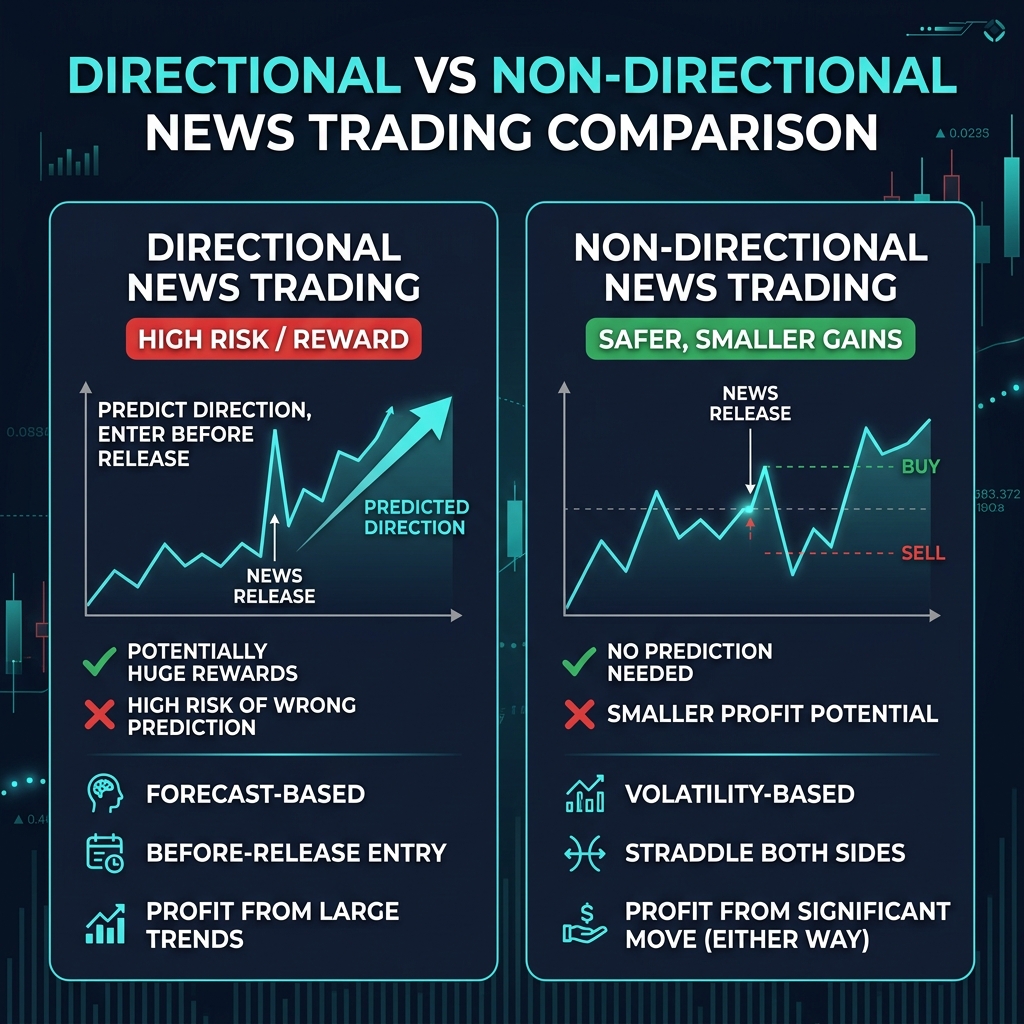
But make no mistake: this is not gambling. Directional news trading is built on research, probability, and strict risk management. This lesson shows you the framework.
When Directional Trading Works
Directional trades work best when:
- Economic data has been trending in one direction — if the last 3 CPI readings have been declining, the probability of another decline is higher
- Market positioning is extreme — if everyone is positioned for a rate hike and the data supports it, the move can be explosive
- Leading indicators confirm your thesis — use early data releases (ADP, regional Fed surveys, PMI) to predict the big one
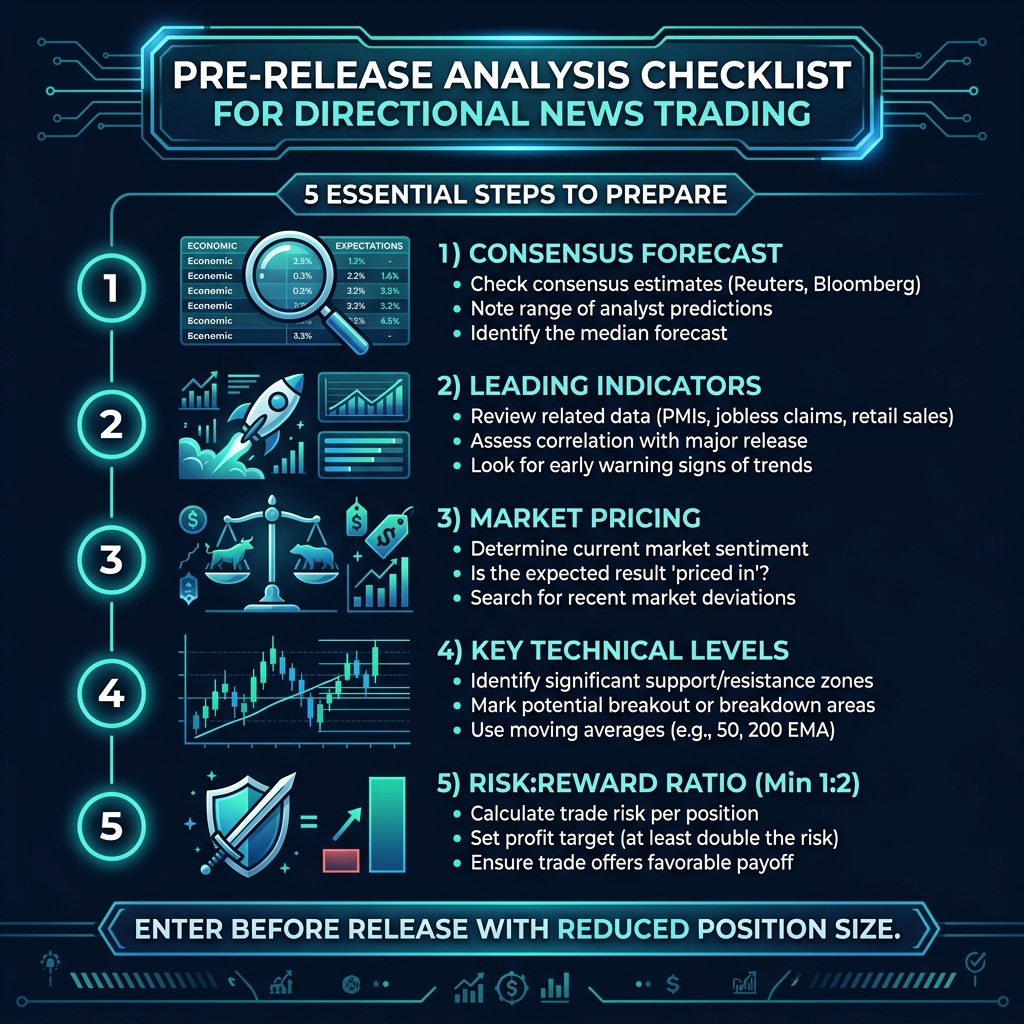
The Pre-Release Analysis Checklist
- What does the consensus forecast say?
- What do leading indicators suggest? (e.g., ADP before NFP)
- What is the market already pricing in? (Check bond markets, Fed Funds futures)
- Where are key technical levels? (Support/resistance that will amplify the move)
- What is the risk:reward ratio for this trade? (Minimum 1:2)
The Directional Trade Setup — Step by Step
Step 1: Form Your Thesis (2-3 Days Before)
Example: "ADP showed strong job growth, regional PMIs are expanding, and initial claims are declining. I believe NFP will beat the 180K forecast. This should strengthen USD."
Step 2: Choose Your Pair and Direction
Pick the pair most sensitive to the data. For US data, look for the weakest counterpart:
- Strong USD thesis → short EUR/USD (if EUR is weak) or short GBP/USD
- Weak USD thesis → long AUD/USD or long EUR/USD
Step 3: Enter 15-60 Minutes Before the Release
- Enter your position with a reduced position size (50% of normal) — this is a high-risk trade
- Set a stop loss beyond the opposite scenario's key level
- Set two take profit levels (TP1 at 1:1 R:R, TP2 at 1:2+)
Step 4: Manage the Reaction
- If the data confirms your thesis → price moves in your favor → trail your stop
- If the data contradicts your thesis → price moves against you → stop loss protects you
- Close 50% at TP1, let the rest run with a trailing stop
Example: Directional Trade on NFP
| Component | Detail |
|---|---|
| Thesis | NFP will beat forecast (200K vs 180K expected) based on strong ADP and low claims |
| Pair | Short EUR/USD (EUR showing weakness) |
| Entry | 1.0880 — 30 minutes before NFP |
| Stop Loss | 1.0930 (50 pips) — above H4 resistance |
| TP1 | 1.0830 (50 pips) = 1:1 |
| TP2 | 1.0780 (100 pips) = 1:2 |
| Position Size | 50% of normal (halved due to event risk) |
| Result | NFP came in at 227K → USD surged → hit TP2 within 4 hours ✅ |
Risks of Directional Trading
- Whipsaws: Price spikes one way, then reverses immediately — you get stopped out, then the market goes where you predicted
- Spread widening: Brokers widen spreads 3-5x during high-impact events — your entry and stop may fill at worse prices
- Headline vs details: NFP might beat forecast but wages miss badly — the market focuses on the worst number
- Revised data: Previous month's number gets revised, changing the narrative completely
Risk management rule: Never risk more than 0.5% of your account on a single directional news trade. This is high-variance trading — position size accordingly.
Quick Recap
- Directional trading = entering before the release with a specific bias
- Build your thesis using leading indicators, trends, and market positioning
- Always use reduced position size (50% of normal) and strict stop losses
- The biggest risk is whipsaws — plan for them by using wider stops
- Close 50% at TP1, trail the rest — don't be greedy
- Never risk more than 0.5% per trade on news events
🎯 Your Action Step
Before the next NFP release, run through the 5-point Pre-Release Analysis Checklist. Write down your thesis: "I believe NFP will beat/miss because [leading indicators]." Then watch the release — don't trade it yet, just observe. Did your thesis match the outcome? Did the market react as you predicted? After 3 months of practice analysis, you'll be ready to take directional trades with real money.