The Best Free Gift Your Broker Will Ever Give You
Every reputable broker offers a demo account — a risk-free trading environment loaded with virtual money. It's essentially a flight simulator for traders. You get the same charts, the same prices, the same tools — but with zero risk.
Sounds perfect, right? It is… if you use it correctly. The problem is, most beginners use demo accounts wrong, and that sets them up for disaster when they switch to real money.
This lesson teaches you how to use a demo account as a genuine learning tool — not just a playground where nothing feels real.
Demo vs Live — What Actually Changes?
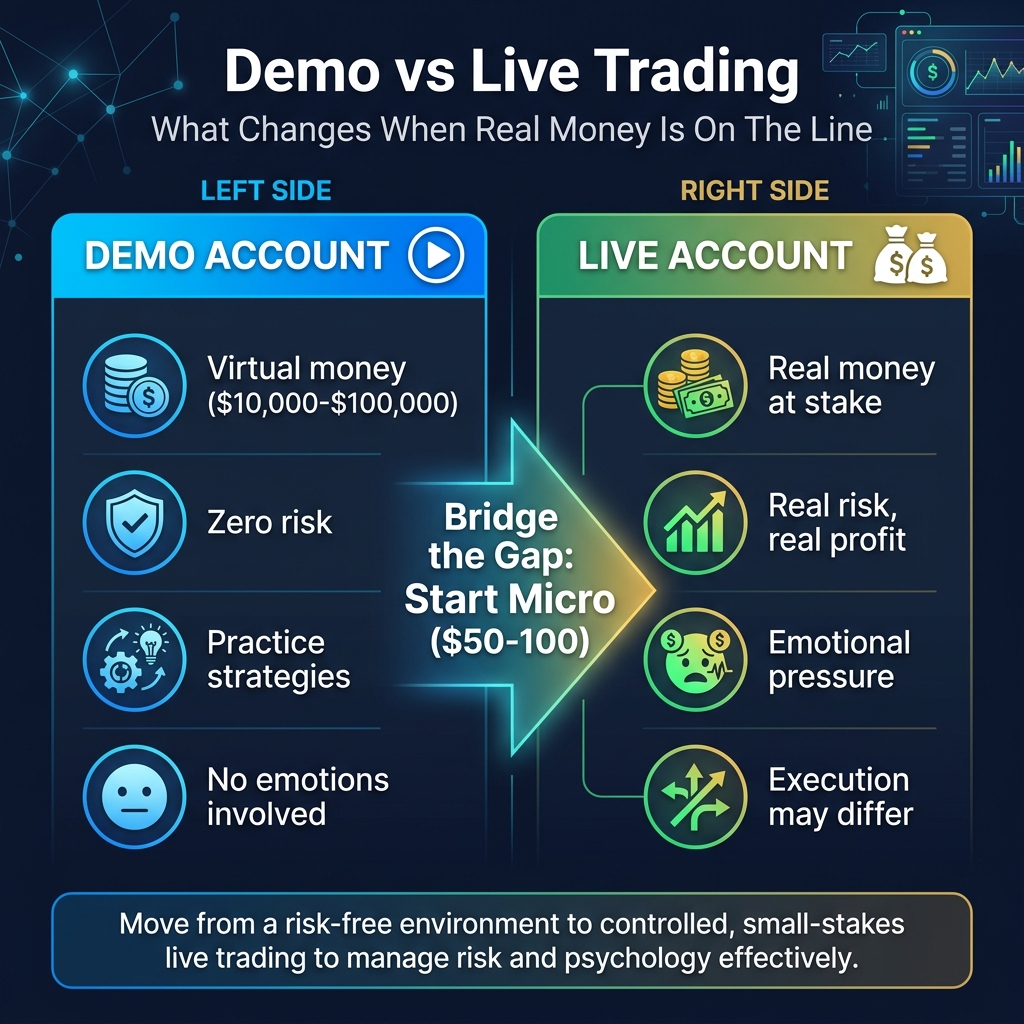
| Factor | Demo Account | Live Account |
|---|---|---|
| Capital | Virtual ($10K-$100K) | Your real money |
| Risk | Zero | 100% real |
| Emotions | Almost none | Fear, greed, anxiety |
| Execution | Perfect (no slippage) | Real-world conditions |
| Behavior | Often reckless | Hopefully disciplined |
| Purpose | Learn & practice | Generate profit |
The biggest shift isn't technical — it's psychological. On demo, you don't feel losses. On live, a $50 loss can make you panic, revenge trade, and lose $500. That's why how you use your demo matters enormously.
What Demo Accounts Are ACTUALLY Good For
Use your demo account for these specific purposes:
1. Learning Your Platform
Get familiar with MetaTrader 4/5 or whatever platform your broker offers. Learn to: place market orders, set stop loss and take profit, switch timeframes, add indicators, and read the trade terminal.
2. Testing Strategies
Before risking real money on a new strategy, test it on demo for at least 30-50 trades. This gives you enough data to know if it has an edge or if it's just luck.
3. Practicing Risk Management
Calculate position sizes, set stop losses at logical levels, and practice the 2% rule (never risk more than 2% of your account on a single trade). Make these habits automatic before going live.
4. Building Confidence
Demo trading builds the mechanical confidence you need — clicking buttons, managing multiple positions, reading charts under pressure. Think of it as muscle memory for trading.
The 5 Demo Mistakes That Guarantee Failure
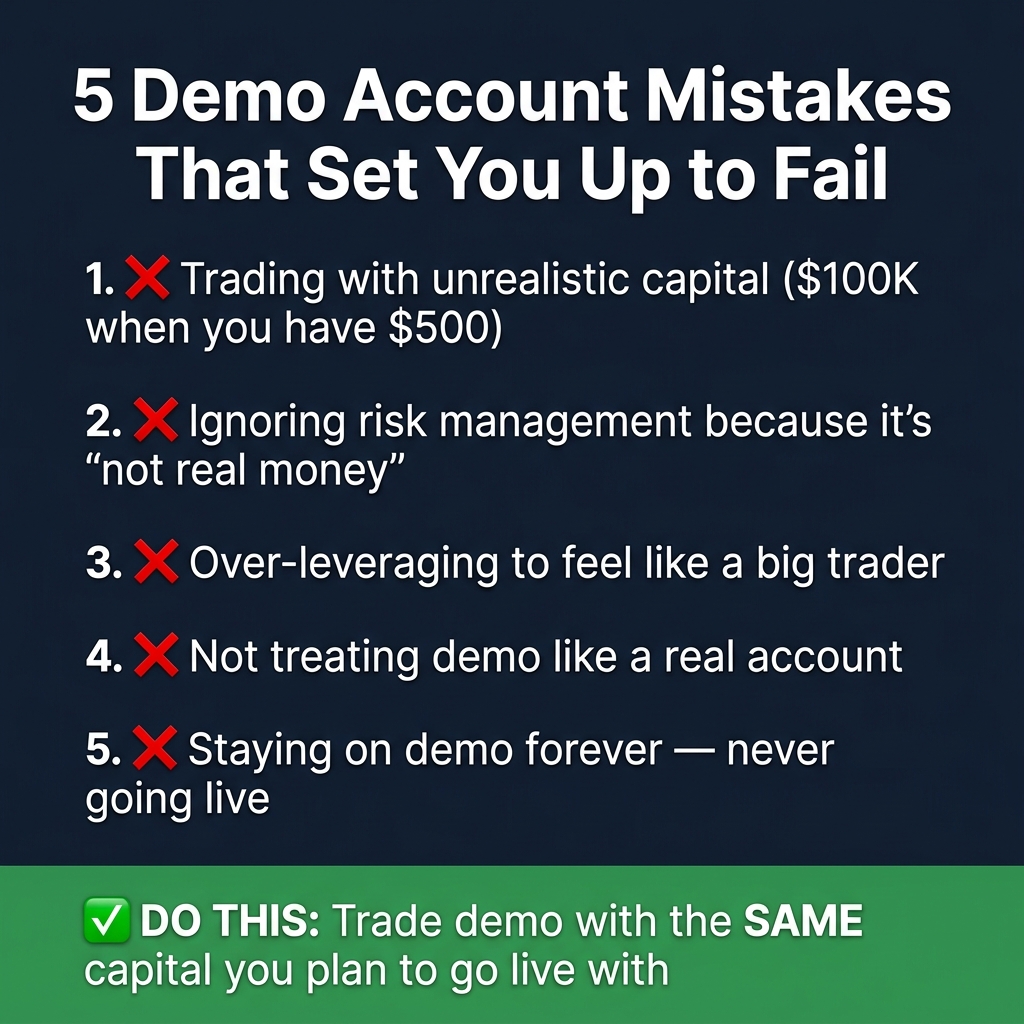
Mistake #1: Unrealistic Capital
Your broker gives you a $100,000 demo account, but you plan to start live with $500. Trading with $100K creates habits that don't translate to $500. Set your demo balance to match your planned live deposit.
Mistake #2: Ignoring Risk Management
"It's not real money, so who cares?" This is the #1 mindset trap. If you don't practice proper position sizing and stop losses on demo, you definitely won't do it with real money under pressure.
Mistake #3: Over-Leveraging
Opening massive positions because losses don't hurt. On live, those same positions would wipe your account in minutes. Trade demo as if every dollar were real.
Mistake #4: Not Taking It Seriously
Random trades, no analysis, no journal, no strategy. If your demo trading looks like gambling, your live trading will too.
Mistake #5: Staying on Demo Forever
Some traders spend years on demo because they're afraid of losing real money. At some point, you need to make the jump. Demo can teach you mechanics, but it can never teach you to handle real emotions.
The Smart Demo-to-Live Transition
Here's the roadmap that actually works:
- Weeks 1-2: Learn the platform. Place 20+ practice trades. Learn every button, every feature.
- Weeks 3-6: Test your strategy. Execute 30-50 trades with proper risk management. Track every trade in a journal.
- Week 7-8: Review results. Are you profitable? Is your win rate + risk-reward ratio positive? If yes → move to step 4.
- Go live with MICRO capital. Start with $50-$200 and trade the smallest possible positions (0.01 lots). This bridges the gap between demo emotions and real emotions.
- Gradually increase. Only add more capital after 2-3 months of consistent micro-live results.
🎯 The golden rule: Trade your demo account with the exact same capital, leverage, and lot sizes you plan to use on live. This makes the transition seamless.
Frequently Asked Questions
How long should I stay on demo?
4-8 weeks is the sweet spot. Enough to learn the platform and test a strategy, but not so long that you develop bad habits from zero-risk trading.
Do demo results predict live results?
Partially. The technical performance (strategy win rate) should be similar, but the emotional performance (discipline, patience) will be very different on live.
Can I have multiple demo accounts?
Yes — most brokers allow unlimited demo accounts. Use one for learning, another for strategy testing, and a third for experimental trades.
Quick Recap
- ✅ Demo accounts are essential for learning — use them seriously
- ✅ Match your demo capital to your planned live deposit
- ✅ Practice proper risk management from day one
- ✅ Don't stay on demo forever — transition to micro-live after 4-8 weeks
- ✅ Demo teaches mechanics; live teaches emotions
🎯 Your Action Step
Open a demo account with your chosen broker right now. Set the balance to match your planned live deposit. Place your first trade — a small buy on EUR/USD with a 20-pip stop loss and 40-pip take profit. Congratulations, you just completed your first proper trade setup!
Next module: → The Three Lenses of Analysis