8 People Control the Entire Forex Market
Every major forex pair is controlled — directly or indirectly — by a small group of central bank governors. When the Fed Chair speaks, USD moves. When the ECB President hints at policy, EUR reacts. These are not market participants. They are the market.
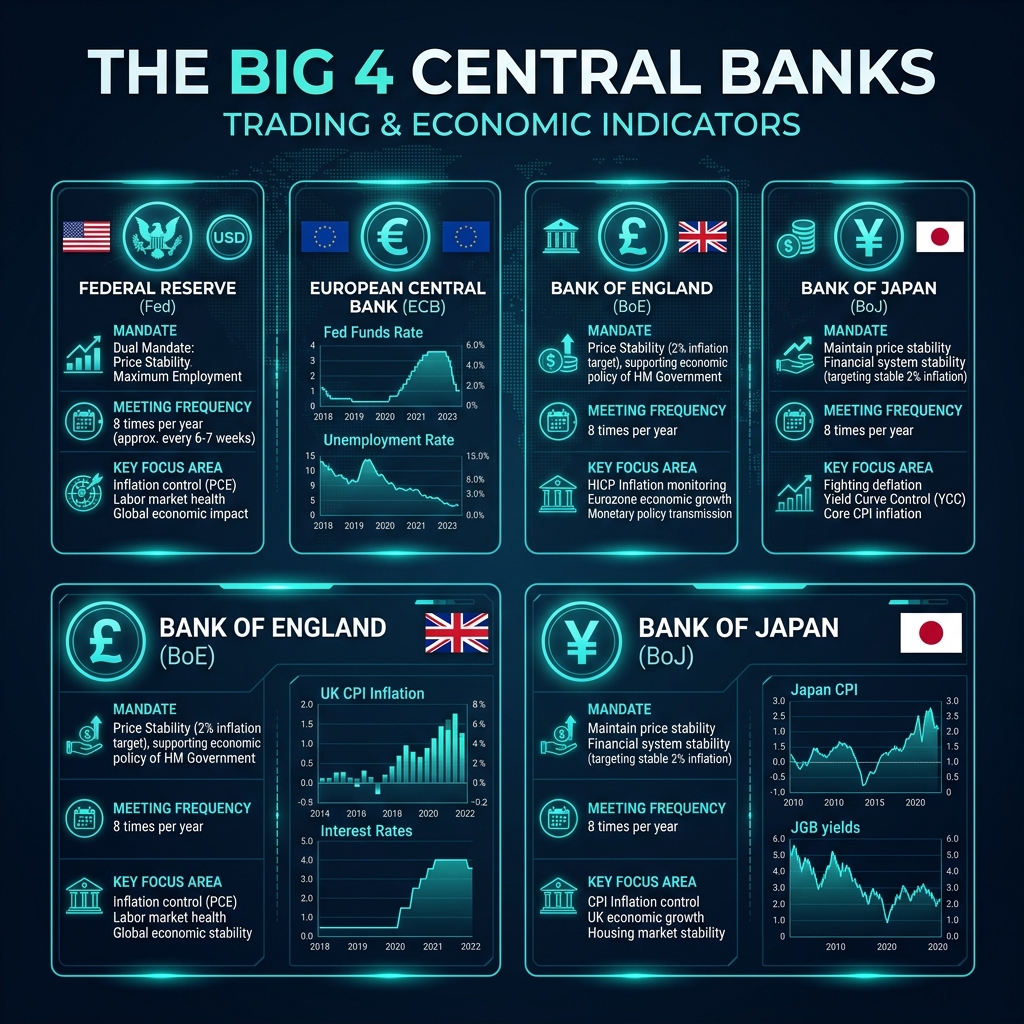
This lesson breaks down the 4 most important central banks for forex traders, what they control, and how to read their signals before they move your positions.
The Big Four Central Banks
| Central Bank | Currency | Key Focus | Meeting Frequency |
|---|---|---|---|
| Federal Reserve (Fed) | USD | Dual mandate: maximum employment + stable prices (2% inflation) | 8x per year (FOMC) |
| European Central Bank (ECB) | EUR | Price stability across 20 eurozone countries | 6x per year (rate decisions) |
| Bank of England (BoE) | GBP | Inflation target 2%, financial stability | 8x per year (MPC) |
| Bank of Japan (BoJ) | JPY | Price stability, ultra-loose policy for decades | 8x per year |
The Federal Reserve (Fed) — The World's Most Powerful Central Bank
The USD is involved in 88% of all forex transactions. That makes the Fed the single most important institution for currency traders. When the Fed speaks, every market on earth listens.
What the Fed Controls
- Federal Funds Rate: The benchmark interest rate — directly impacts USD strength
- Quantitative Easing/Tightening: Buying or selling bonds to control money supply
- Forward Guidance: Verbal signals about future policy — this moves markets more than actual decisions
Key Signals to Watch
- FOMC Statement: Released after every meeting — every word is analyzed
- Dot Plot: Shows where each Fed member expects rates to be in the future
- Fed Chair Press Conference: 30 minutes of market-moving Q&A
- FOMC Minutes: Released 3 weeks after each meeting — reveals internal debate
The European Central Bank (ECB) — Managing 20 Economies at Once
The ECB faces a unique challenge: setting one monetary policy for 20 different countries with vastly different economies. Germany's needs are not Greece's needs. This tension creates both complexity and opportunity for traders.
What Makes the ECB Different
- Single mandate: Price stability only (unlike the Fed's dual mandate)
- Political complexity: Must balance the interests of 20 member states
- Slower to act: Consensus-building takes time — the ECB tends to lag behind the Fed
Trading tip: When the Fed and ECB diverge in policy (Fed hiking while ECB holds), EUR/USD tends to make massive moves. This divergence is one of the most tradeable setups in fundamental analysis.
The Bank of England (BoE) — Brexit's Shadow
The BoE is one of the oldest central banks in the world (founded 1694). It operates independently from the UK government but with a clear inflation target of 2%. Since Brexit, GBP has become more volatile and more sensitive to BoE decisions.
What to Watch
- MPC vote split: If members are divided (5-4 vote vs 9-0), it signals uncertainty
- Inflation Report (Monetary Policy Report): Detailed economic projections
- Governor speeches: Often hint at policy changes before official meetings
The Bank of Japan (BoJ) — The Outlier
For over two decades, the BoJ has been the world's most dovish central bank. While other central banks raised rates to fight inflation, the BoJ kept rates at or below zero — and even implemented yield curve control (literally capping how high bond yields could go).
Why the BoJ Matters for Forex
- JPY carry trades: Japan's ultra-low rates make JPY the world's favorite funding currency
- Surprise interventions: The BoJ has directly bought/sold USD/JPY to prevent extreme moves
- Any policy shift is massive: When the BoJ finally began raising rates in 2024, JPY moved 1,000+ pips
Other Central Banks Worth Tracking
| Central Bank | Currency | Why It Matters |
|---|---|---|
| Reserve Bank of Australia (RBA) | AUD | Commodity-driven; sensitive to China growth |
| Bank of Canada (BoC) | CAD | Oil-linked currency; closely follows Fed |
| Swiss National Bank (SNB) | CHF | Safe haven; known for surprise interventions |
| Reserve Bank of New Zealand (RBNZ) | NZD | Small economy, high volatility around decisions |
Hawkish vs Dovish — The Language of Central Banks
Central bankers rarely say "we will raise rates." Instead, they use carefully coded language. Learning to decode it gives you a head start.
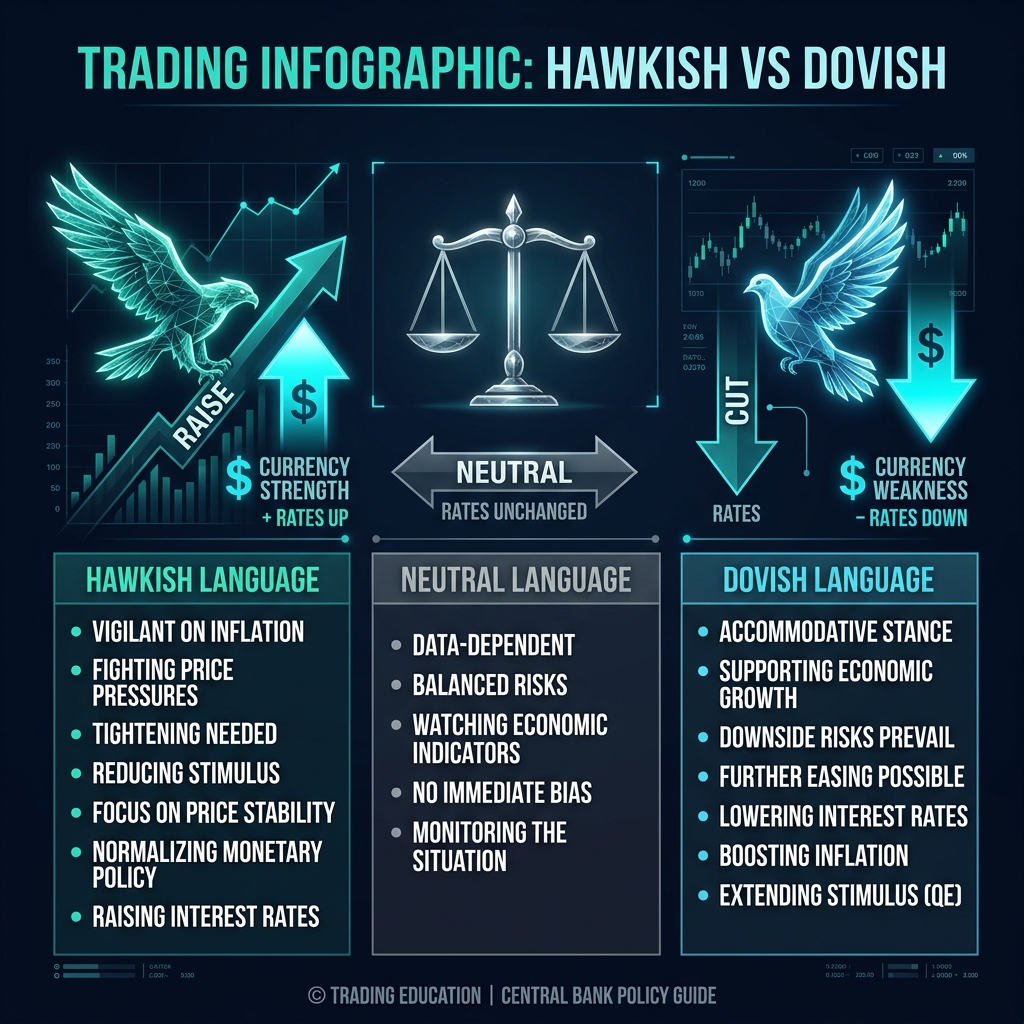
| Language Type | Phrases You'll Hear | What It Means | Currency Impact |
|---|---|---|---|
| Hawkish | "Vigilant on inflation," "further tightening may be needed" | Rates likely to rise or stay high | Bullish for currency ↑ |
| Dovish | "Accommodative stance," "data-dependent," "downside risks" | Rates likely to fall or stay low | Bearish for currency ↓ |
| Neutral | "Balanced risks," "monitoring developments" | No clear direction — wait and see | Minimal impact |
Quick Recap
- The Fed, ECB, BoE, and BoJ are the four central banks that matter most for forex
- The Fed controls the world's reserve currency — it's the most powerful by far
- Forward guidance (what they say) moves markets more than rate decisions (what they do)
- Learn to decode hawkish vs dovish language — it's the market's early warning system
- Policy divergence between central banks creates the biggest trends
- The BoJ is the outlier — any policy change creates massive JPY moves
🎯 Your Action Step
Find the next scheduled meeting for the Fed, ECB, BoE, and BoJ. Write them on your calendar. Before the next Fed meeting, read the last FOMC statement and highlight any hawkish or dovish phrases. Then watch the market reaction live when the new statement drops. This trains you to read central bank language like a professional.