From Blank Page to Battle-Tested Strategy in 6 Steps
You know you need a system. But how do you actually build one? Most traders skip this step entirely — they grab a random strategy from YouTube, slap on a few indicators, and start trading live. Six months later, they're broke and confused.
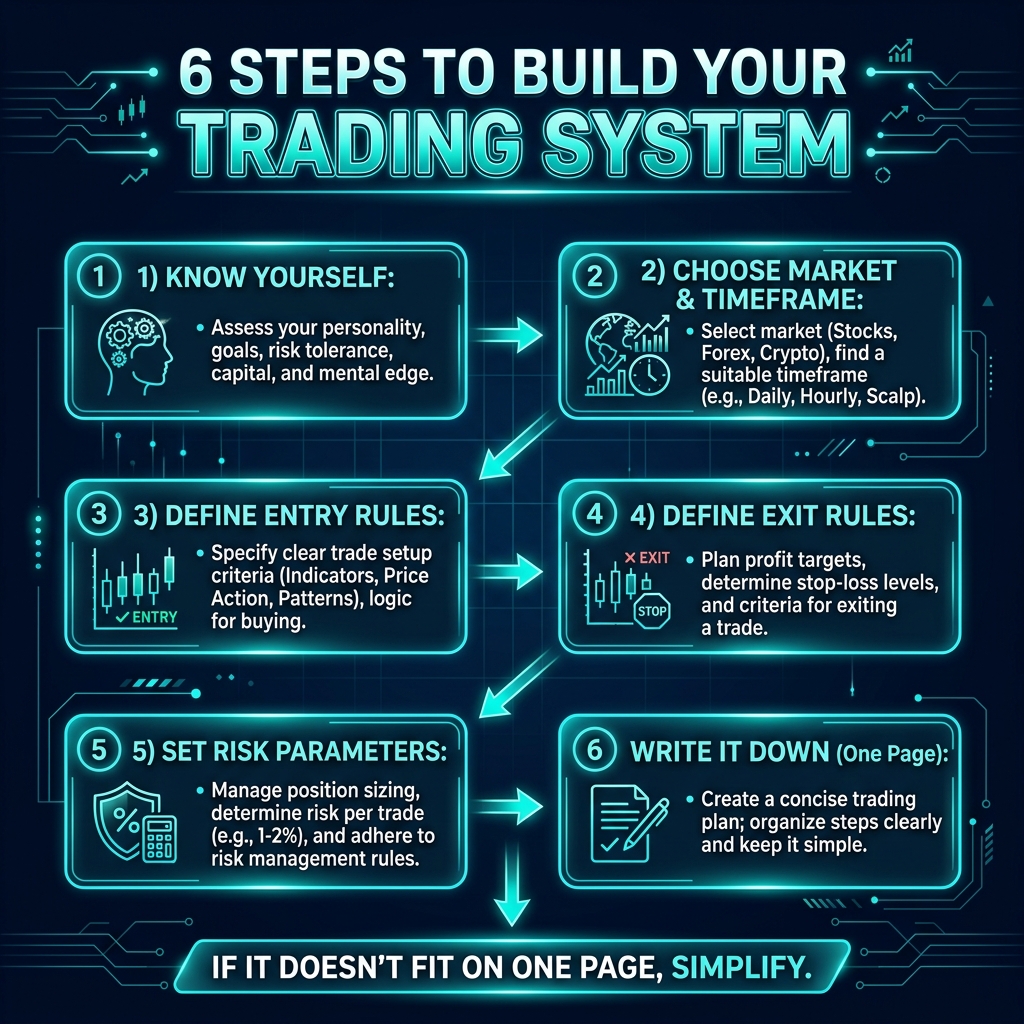
This lesson gives you the exact 6-step process for building a trading system from scratch — one that fits YOUR personality, YOUR schedule, and YOUR risk tolerance.
Step 1: Know Yourself First
Before you choose a single indicator, answer these questions honestly:
| Question | Why It Matters | What It Determines |
|---|---|---|
| How many hours per day can you trade? | Determines your style — scalp, day, swing, or position | Timeframe and session |
| Can you hold trades overnight? | Some traders can't sleep with open positions | Day trading vs swing trading |
| How do you handle losing streaks? | If 5 losses crushes you, you need higher win-rate systems | Win rate vs risk:reward balance |
| What's your account size? | Determines position sizing and realistic expectations | Risk per trade and target returns |
| Are you patient or impulsive? | Patient → swing trading. Impulsive → need strict rules + alerts | Trading style and safeguards |
Your system must fit your personality — not the other way around. A scalping system won't work for someone who checks charts once a day. A swing system won't work for someone who can't resist closing early.
Step 2: Choose Your Market and Timeframe
Market Selection
Don't try to trade everything. Start with 2-3 instruments maximum. Focus on pairs you understand and that have good liquidity/low spreads:
- Forex starters: EUR/USD, GBP/USD, USD/JPY
- Gold: XAU/USD (if you want higher volatility)
- Indices: US30, NAS100 (if you want stock market exposure)
Timeframe Selection
| Style | Analysis TF | Entry TF | Hold Time | Trades/Week |
|---|---|---|---|---|
| Scalping | M15-H1 | M1-M5 | Minutes | 20-50 |
| Day Trading | H1-H4 | M15-H1 | Hours | 5-15 |
| Swing Trading | D1-W1 | H4-D1 | Days-Weeks | 2-5 |
| Position Trading | W1-MN | D1-W1 | Weeks-Months | 1-2 |
Step 3: Define Your Entry Rules
Your entry rules should answer: "What EXACTLY needs to happen for me to press buy or sell?"
A good entry system uses 2-3 confluence factors. More than 4 = over-filtering (you'll never trade). Less than 2 = not enough confirmation.
Example Entry System: Swing Trading
- Trend filter: Price above 200 EMA on D1 (only long trades)
- Structure: Price pulls back to a key support level on H4
- Confirmation: Bullish engulfing or pin bar at support
- Timing: Entry at close of confirmation candle
All 3 conditions must be present. If even one is missing — no trade. This is what "rules, not feelings" means in practice.
Step 4: Define Your Exit Rules
Most traders obsess over entries but have no plan for exits. Your exit rules are just as important — they determine how much you actually keep.
Exit Framework
- Stop Loss: Below the swing low + 5 pip buffer (for longs). Set BEFORE entry. Never move it further away.
- Take Profit 1: At 1:1 risk-reward. Close 50% of position here.
- Take Profit 2: At 1:2 risk-reward. Close remaining 50%, or trail stop to breakeven.
- Maximum hold time: If trade hasn't reached TP1 within 3 days (for swing), close at market.
Step 5: Set Your Risk Parameters
| Parameter | Rule | Reasoning |
|---|---|---|
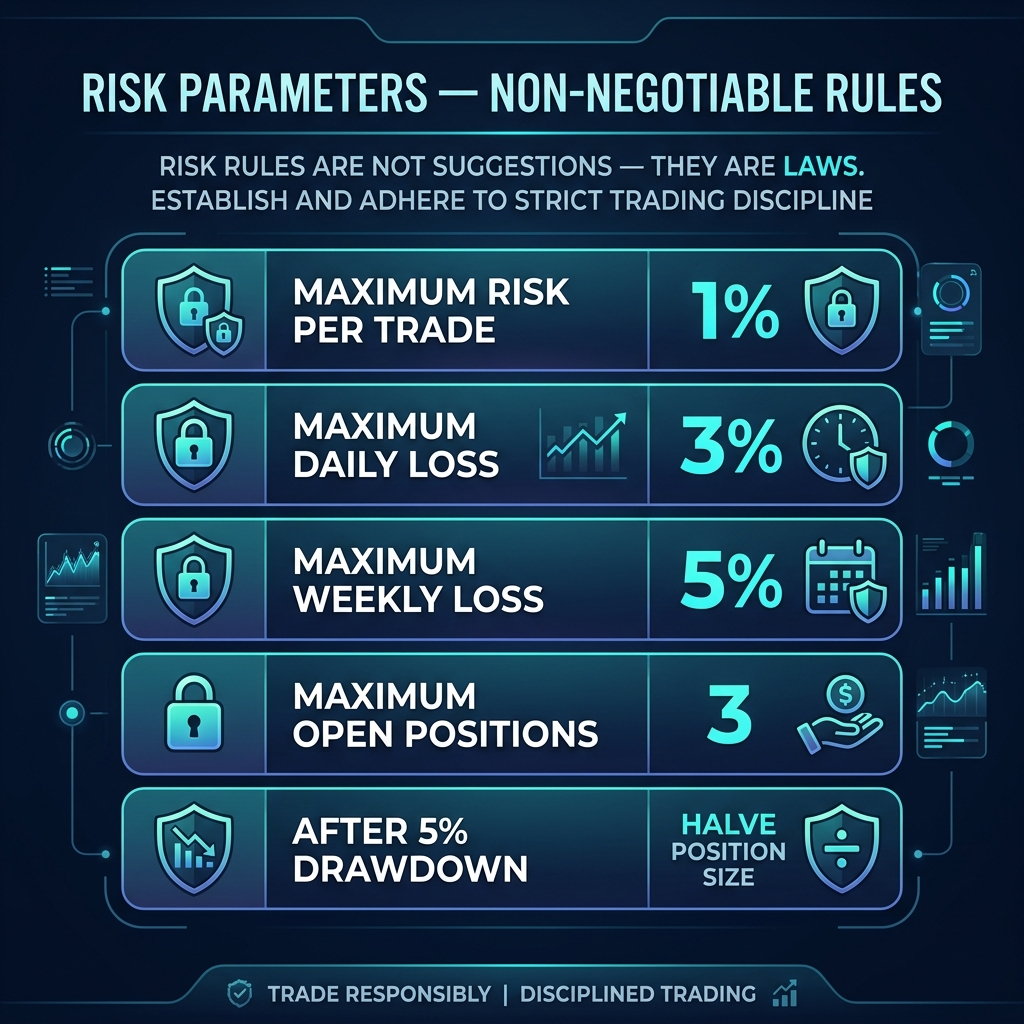
| Risk per trade | 1% of account | Survives 10 consecutive losses with 90% of account intact |
| Max daily loss | 3% of account | Prevents revenge trading spirals |
| Max weekly loss | 5% of account | Forces a pause and review |
| Max open trades | 3 at any time | Prevents over-exposure and correlation risk |
| Drawdown protocol | After 5% drawdown → halve position size | Protects capital during losing streaks |
Step 6: Write It Down — The One-Page System
Your entire system should fit on one page. If it doesn't, it's too complicated. Print it. Tape it next to your screen. Read it before every session.
Template
- Markets: [List your 2-3 pairs]
- Style: [Scalp / Day / Swing / Position]
- Analysis TF: [Your analysis timeframe]
- Entry TF: [Your entry timeframe]
- Entry Rules: [List your 2-3 conditions]
- Stop Loss: [Where and how calculated]
- Take Profit: [TP1, TP2, trail rules]
- Risk per trade: [% of account]
- Max daily loss: [% then stop trading]
- Drawdown rule: [What triggers size reduction]
- Session: [When you trade — London, NY, Asian]
Quick Recap
- Building a system follows 6 steps: know yourself → choose market/TF → entry rules → exit rules → risk rules → write it down
- Your system must fit your personality — don't force a style that conflicts with who you are
- Use 2-3 confluence factors for entries — not more, not fewer
- Define exits BEFORE entry — stop, TP1, TP2, max hold time
- Risk rules are non-negotiable: 1% per trade, 3% daily max, 5% weekly max
- Write it all on one page. If it doesn't fit, simplify
🎯 Your Action Step
Use the one-page template above and fill it in completely — right now. Don't worry if it's not perfect. The first version is never perfect. What matters is that you HAVE a system. You'll refine it through backtesting and forward testing in the next lessons. But you can't test what doesn't exist.