The Market Most Traders Never Watch — But Should
The bond market is bigger than the stock market. It moves trillions of dollars daily. And yet most retail forex traders never look at it. This is a massive oversight — because bond yields are one of the most reliable predictors of currency direction.
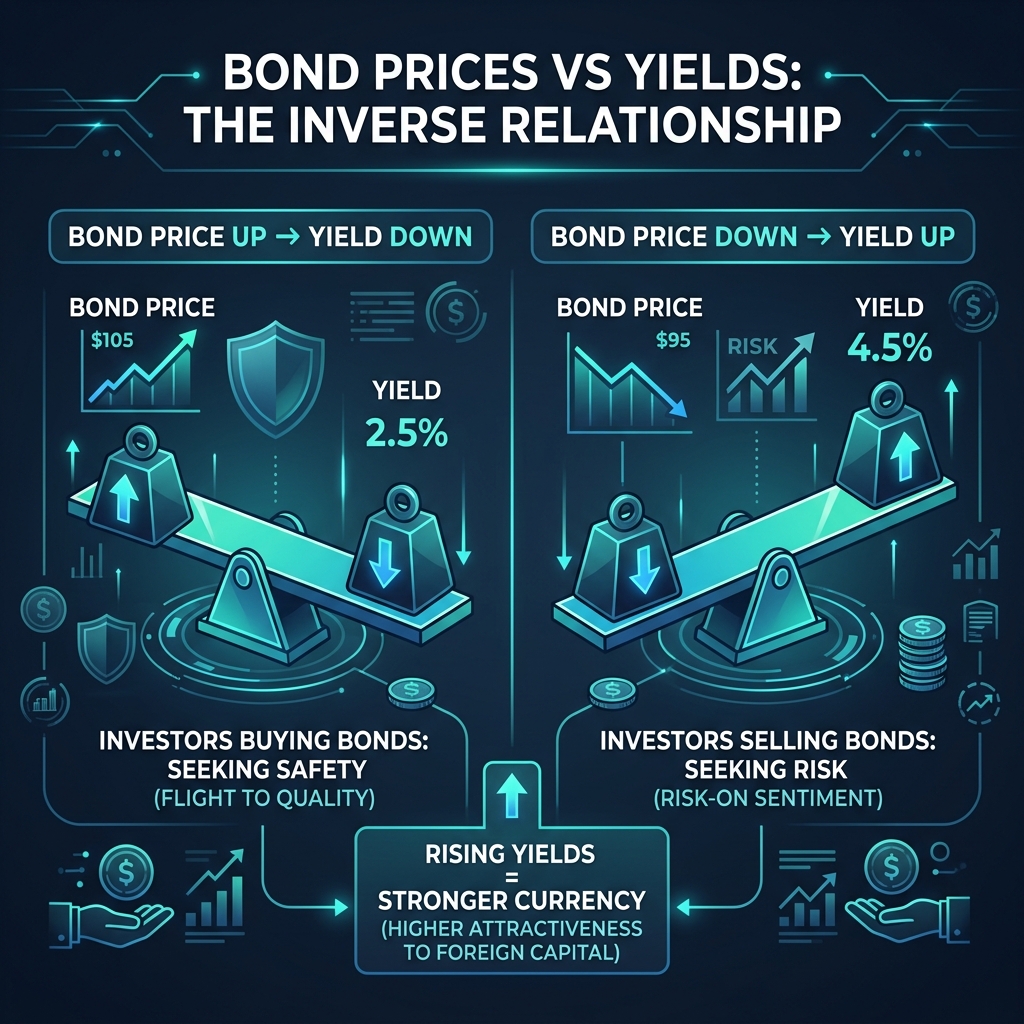
In fact, if you understand only one cross-market relationship, make it this one: rising yields = stronger currency. That single insight will improve every trade you take.
Bonds 101 — What You Need to Know
A government bond is essentially a loan to a government. You buy the bond, they pay you interest (the "yield"). That's it.
The Key Relationship: Price vs Yield
Bond prices and yields move in opposite directions:
- When demand for bonds rises → bond prices rise → yields fall
- When demand for bonds falls → bond prices fall → yields rise
Why This Matters for Forex
International investors are always looking for the best yield. Money flows to countries with higher bond yields. To buy those bonds, investors need to buy that country's currency.
- US 10-year yield rises → foreign investors buy US bonds → they need USD → USD strengthens
- German bund yields rise → investors buy bunds → they need EUR → EUR strengthens
Yield Differentials — The Currency Driver
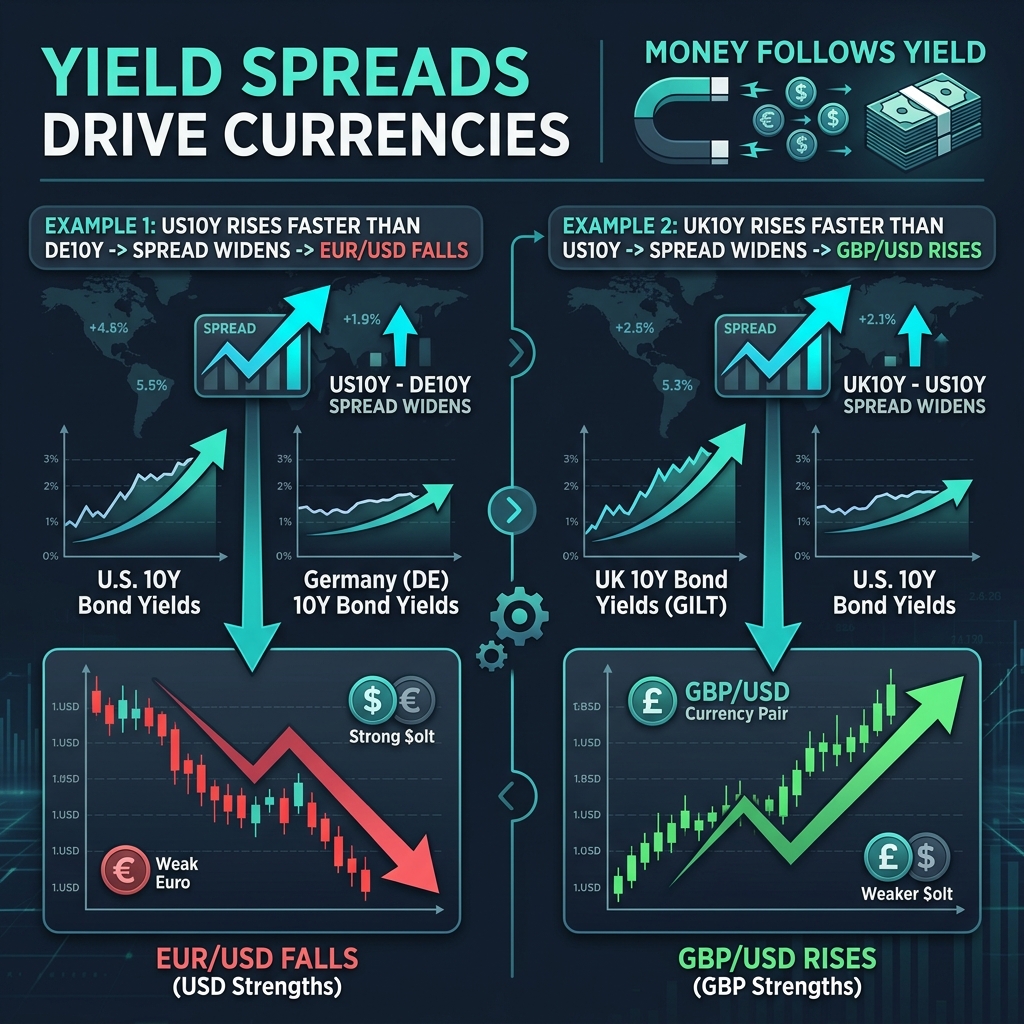
It's not just absolute yields that matter — it's the difference between two countries' yields (the spread). This spread is one of the most powerful predictors of currency direction.
| Scenario | Yield Spread | Currency Effect |
|---|---|---|
| US 10Y yield rises faster than German 10Y | US-DE spread widens | EUR/USD falls (USD gets relatively more attractive) |
| UK 10Y yield rises faster than US 10Y | UK-US spread widens | GBP/USD rises (GBP becomes more attractive) |
| Japan 10Y stays anchored near zero while US rises | US-JP spread widens | USD/JPY rises sharply (massive yield gap) |
The 2022-2024 USD/JPY rally from 115 to 160 was almost entirely driven by the US-Japan yield spread widening. The BoJ kept rates at zero while the Fed hiked aggressively. That simple yield differential explained a 4,500-pip move.
Key Bond Markets to Watch
| Bond | Currency It Drives | Where to Find |
|---|---|---|
| US 10-Year Treasury (US10Y) | USD — the most important bond in the world | TradingView: US10Y |
| US 2-Year Treasury (US02Y) | USD — more sensitive to Fed rate expectations | TradingView: US02Y |
| German 10-Year Bund | EUR | TradingView: DE10Y |
| UK 10-Year Gilt | GBP | TradingView: GB10Y |
| Japan 10-Year JGB | JPY | TradingView: JP10Y |
How to Use Bonds in Your Forex Trading
- Before trading any USD pair, check US 10Y yield direction. If yields are rising, that's a tailwind for USD strength.
- Compare yield spreads: For EUR/USD, compare US10Y vs DE10Y. Spread widening = EUR/USD bearish.
- Watch for divergences: If EUR/USD is rising but the US-DE yield spread is also widening, something doesn't add up. One of them is wrong — and it's usually the currency that snaps back.
- The 2-Year yield is more important for short-term moves (Fed expectations). The 10-Year is better for macro trends.
Quick Recap
- Bond yields and prices move inversely — higher demand = lower yields
- Rising yields = stronger currency (money flows to higher yield)
- Yield differentials (spreads between countries) are the key driver of currency pair direction
- The US 10Y Treasury is the most important bond in the world — watch it
- Use yield spreads as confirmation for your forex trades, especially on majors
- Divergences between yield direction and price direction are high-probability trade signals
🎯 Your Action Step
On TradingView, add US10Y and DE10Y to your layout. Calculate the spread (simple subtraction). Compare it to EUR/USD on the daily timeframe over the last 6 months. You'll see how closely they correlate — and when they diverge, you'll find some of the best trade setups you've ever seen.