Picking Your Timeframes Is Picking Your Lifestyle
The timeframes you trade aren't just a technical decision — they determine how you live your life. Scalpers stare at screens for hours, reacting in seconds. Swing traders check charts twice a day and spend the rest living. Neither is better — but picking the wrong combo for your personality guarantees burnout and losses.
This lesson gives you the exact timeframe combinations used by professional scalpers, day traders, and swing traders — plus the one critical rule that makes any combo work.
The 4-6x Rule
Before we get into specific combos, understand this rule: each timeframe should be roughly 4-6 times the one below it. This gives enough separation to see different perspectives without being so far apart that they're disconnected.
- M5 → M15-M30 → H1-H4 ✅ (6x, 4-8x)
- M5 → H4 → Monthly ❌ (48x, 120x — way too spread out)
- H1 → H4 → Daily ✅ (4x, 6x — perfect)
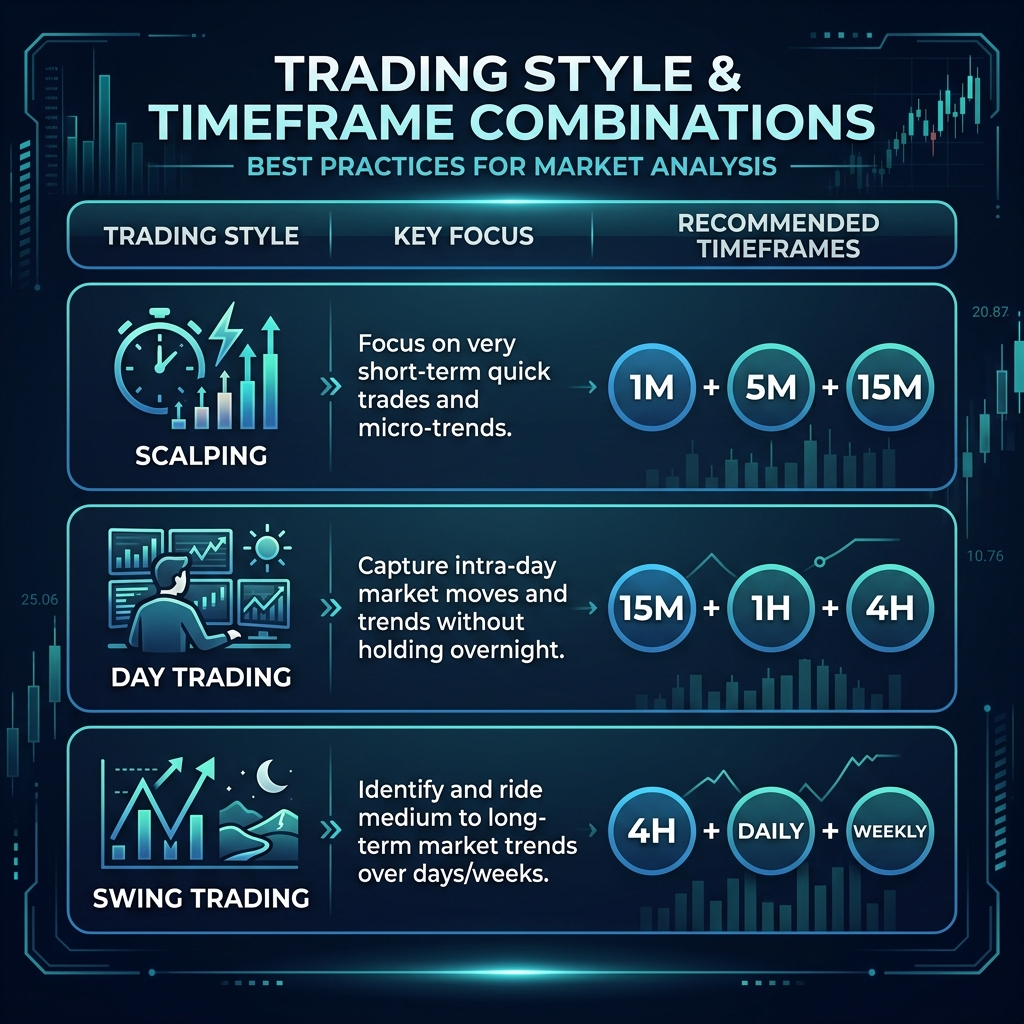
Scalping Combo: Speed and Precision
| Role | Timeframe | Purpose |
|---|---|---|
| Direction | H1 | Overall short-term trend and key levels |
| Setup | M15 | Entry zones, pullbacks, patterns |
| Entry | M5 or M1 | Precise trigger for entry and tight stop |
Characteristics:
- Trades last 5-30 minutes
- Targets: 10-25 pips
- Requires constant screen time during active sessions
- Best during London and London/NY overlap
- Needs tight spreads (EUR/USD, GBP/USD, USD/JPY)
Who it's for: Traders with 2-4 hours of focused screen time, fast decision-makers, people who enjoy the action.
Day Trading Combo: The Balanced Approach
| Role | Timeframe | Purpose |
|---|---|---|
| Direction | H4 | Intraday trend and major S/R |
| Setup | H1 | Trade setups, divergence, patterns |
| Entry | M15 | Entry confirmation, stop placement |
Characteristics:
- Trades last 1-8 hours (all closed by end of day)
- Targets: 30-80 pips
- Check charts every 15-30 minutes during your trading session
- Best during London and NY sessions
- No overnight risk
Who it's for: Traders who can dedicate a specific trading session each day, want reasonable frequency (2-4 trades/day), and prefer no overnight exposure.
Swing Trading Combo: The Patient Approach
| Role | Timeframe | Purpose |
|---|---|---|
| Direction | Daily | Major trend, weekly S/R levels |
| Setup | H4 | Pullbacks, patterns, divergence zones |
| Entry | H1 | Entry signal, stop loss, initial target |
Characteristics:
- Trades last 2-14 days
- Targets: 80-300 pips
- Check charts 2-3 times per day (morning, lunch, evening)
- Works during any session — less session-dependent
- Carries overnight and weekend risk (use proper position sizing)
Who it's for: Traders with a full-time job, patient personalities who can hold trades for days, people who want fewer but bigger trades.
Position Trading Combo: The Macro View
| Role | Timeframe | Purpose |
|---|---|---|
| Direction | Weekly | Major macro trend |
| Setup | Daily | Swing structure, major pullbacks |
| Entry | H4 | Entry confirmation at weekly levels |
Characteristics:
- Trades last weeks to months
- Targets: 300-1000+ pips
- Check charts once per day
- Requires larger account and wider stops
- Most relaxed trading style, closest to investing
Choosing Your Combo — Be Honest With Yourself
| Factor | Scalping | Day Trading | Swing | Position |
|---|---|---|---|---|
| Screen time/day | 2-4 hours | 1-3 hours | 20-30 min | 10 min |
| Trades/week | 15-30+ | 5-15 | 2-5 | 0-2 |
| Stress level | Very High | Medium | Low | Very Low |
| Full-time job friendly | No | Maybe | Yes | Yes |
| Min. account size | $500+ | $1,000+ | $2,000+ | $5,000+ |
Quick Recap
- Use the 4-6x rule between timeframes for proper separation
- Scalpers: H1 → M15 → M5 (fast, intense, requires focus)
- Day traders: H4 → H1 → M15 (balanced, no overnight risk)
- Swing traders: Daily → H4 → H1 (patient, job-friendly)
- Choose based on your lifestyle, personality, and available time — not what looks exciting
🎯 Your Action Step
Be honest: how much screen time can you dedicate each day? Write down your answer. Then pick the timeframe combo that matches. Set up your TradingView with exactly those three timeframes. For the next week, practice analyzing one pair using only your chosen combo. Resist the urge to add more timeframes.