Let Code Trade for You — But Know Exactly When to Pull the Plug
Automated trading — using Expert Advisors (EAs) on MetaTrader or trading bots on other platforms — is one of the most misunderstood topics in trading. Some traders believe automation is the holy grail. Others think it's all a scam. The truth is somewhere in between.
This lesson gives you an honest, practical guide to when automation makes sense, how to evaluate an EA, and the hidden risks that most bot sellers never mention.
What Is Automated Trading?
Automated trading means using software to execute trades based on predefined rules — without manual intervention. The software continuously monitors the market and enters/exits trades when your conditions are met.
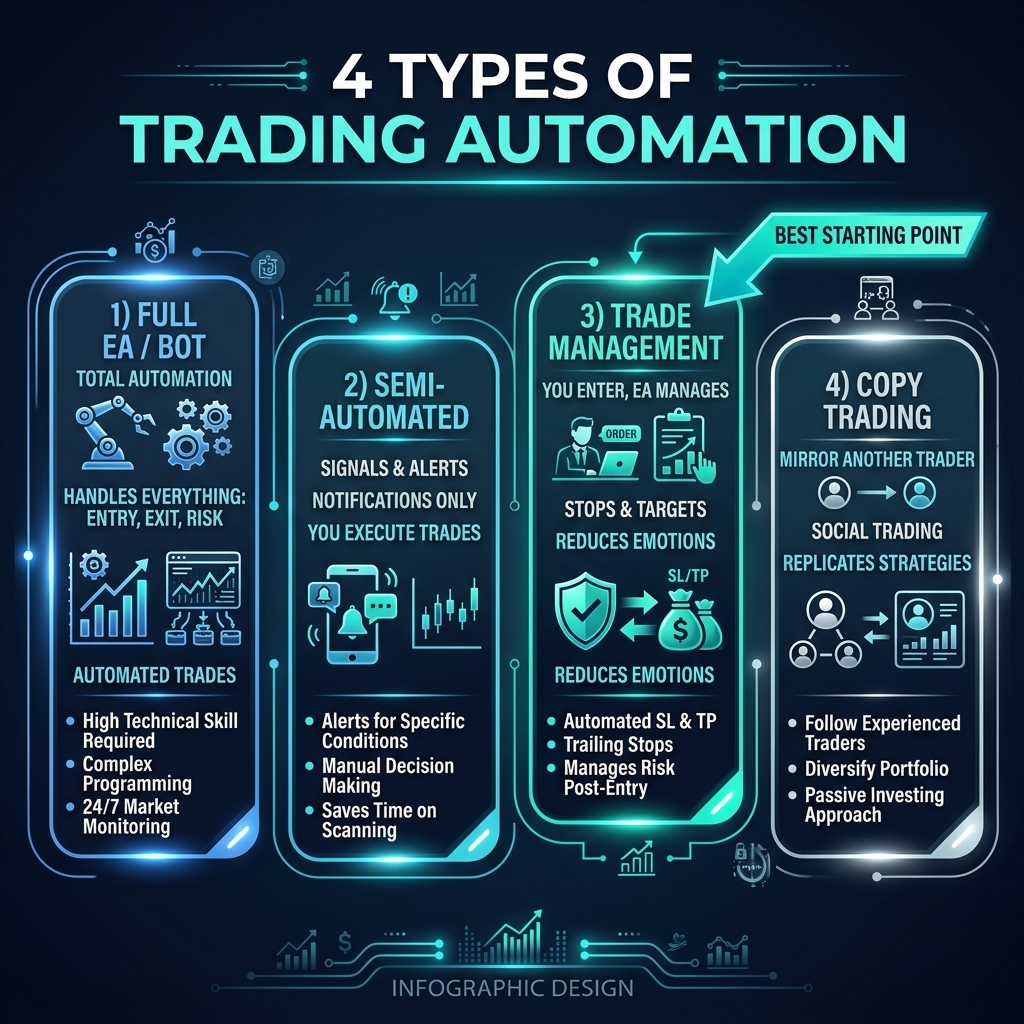
Types of Automation
| Type | What It Does | Skill Required |
|---|---|---|
| Full EA/Bot | Handles everything: entry, exit, risk management, 24/5 | High — understanding code or trusting a developer |
| Semi-automated | Sends alerts when setup appears. You execute manually. | Medium — best of both worlds |
| Trade management | You enter manually. EA manages trailing stop, partial close, breakeven. | Low — most practical starting point |
| Copy trading | Mirrors another trader's positions automatically | Low — but you depend entirely on someone else |
When Automation Makes Sense
- When you have a proven manual system that you want to scale — you know the rules work, and you want more consistency
- When you can't watch the market 24/5 — a bot can monitor and execute while you sleep or work
- When emotional execution is your weakness — if you consistently break rules due to fear/greed, a bot removes the human factor
- When your strategy is purely mechanical — no discretion required, every condition is binary (yes/no)
When It Doesn't
- When you don't understand the strategy — if you can't manually trade the system, you can't debug the bot
- When market conditions change — bots don't adapt. A trending market bot will lose in ranges unless you intervene
- When you treat it as "passive income" — bots require monitoring, updating, and sometimes stopping
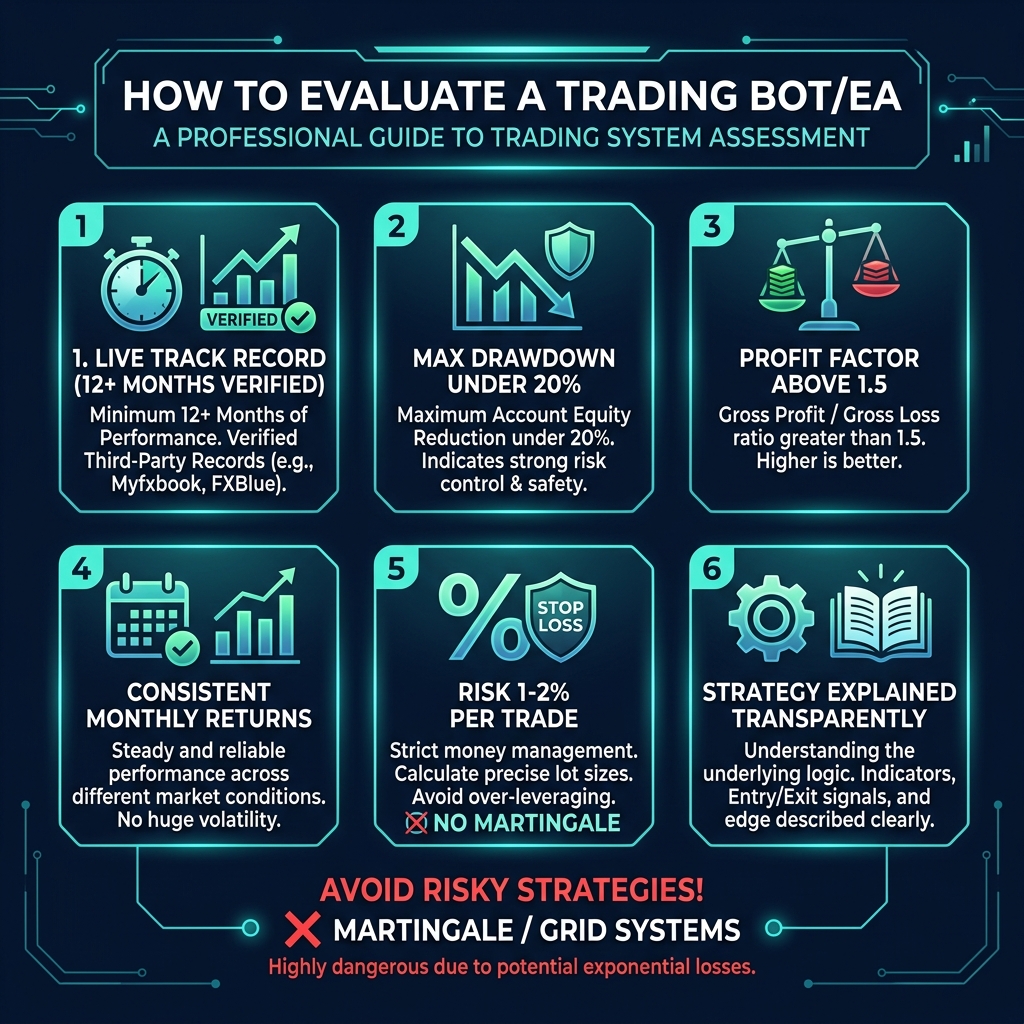
How to Evaluate an EA/Bot
| Metrics | What to Look For | Red Flag |
|---|---|---|
| Live track record | Myfxbook or FX Blue verified, 12+ months | Only backtested results. No live data. |
| Drawdown | Max drawdown under 20% | Drawdown over 40% — eventual blow-up likely |
| Profit factor | Above 1.5 on live account | Under 1.2 — barely profitable after spreads/commissions |
| Consistency | Positive most months, no extreme spikes | One huge month followed by flat/negative months — luck, not edge |
| Risk per trade | 1-2% per trade, visible in settings | Martingale or grid systems (doubling down on losses — guaranteed blow-up) |
| Strategy transparency | Developer explains the logic clearly | "Secret algorithm" — if they can't explain it, they don't understand it |
The Hidden Risks of Trading Bots
- Curve fitting: Bots optimized to perfection on historical data often fail spectacularly on live markets. Past performance really doesn't guarantee future results.
- Broker dependency: Spread widening, slippage, and server latency affect bot performance more than manual trades
- Black swan events: Bots don't understand context. A bot will happily buy EUR/USD 10 minutes before an unexpected war breaks out.
- Over-optimization: A bot with 47 parameters fitted to 2 years of data will fail. Simple strategies automate better.
Quick Recap
- Automation ranges from full EA to trade management helpers — start with semi-automated
- Only automate a strategy you can trade manually and understand deeply
- Evaluate any EA using live verified results (12+ months), not just backtests
- Avoid Martingale and grid systems — they guarantee eventual account blow-ups
- Monitor your bot regularly — automation ≠ "set and forget"
- The best starting point: trade management EAs that handle trailing stops and partial closes while you enter manually
🎯 Your Action Step
If you use MetaTrader, explore the trade management EA approach first. Set up an EA that moves your stop to breakeven after reaching 1:1 R:R and trails it behind swing points. This single automation eliminates the emotional challenge of managing winners while keeping you in control of entries. You get the best of both worlds: human judgment + machine discipline.